
This article was prepared for the popular-history series of NAnews, “Jews from Ukraine.” We do not claim to have conducted an original historical investigation or to have definitively resolved scholarly debates. Our aim is to introduce a broad readership to little-known chapters of shared Ukrainian-Jewish history, and to the people, events, and documents behind them. Historians interpret some of the evidence differently. Readers wishing to explore the subject in greater depth are encouraged to consult the academic studies, archival documents, and firsthand memoirs themselves. The principal sources are listed at the end of the article.
Series: “Jews from Ukraine” | Author: the editors of NAnews — Nikk.Agency
In November 1918, a young Jewish serviceman named Chaim Kahane joined Ukrainian formations fighting for Lviv. Thirty years later, he would help establish the first parachute units of independent Israel’s army.
His biography is just one of the dozens of stories gathered in this extensive article.
Our article names around 100 Jewish participants in these events and historical figures. Approximately 60–70 of them were involved in military service, armed self-defense, or the organization of Jewish military units. Many of these people have been almost forgotten. Others became prominent politicians, public figures, military leaders, and participants in the founding of the State of Israel.
The story takes us through the years 1917–1921, dozens of Ukrainian cities and towns, Jewish commanders, volunteers, armed militias, and units of the Ukrainian army. These are stories of courage, cooperation, tragic losses, and individual lives that continued far beyond Ukraine’s borders.
We will introduce Solomon Leinberg, who formed the Jewish Assault Battalion of the Ukrainian Galician Army, and Salko Rottenberg, commander of a mixed Jewish-Ukrainian mounted machine-gun company. We will tell the story of more than 80 Jewish volunteers in the Hutsul Battalion and eight fighters killed and buried near Pidkamin.
In Odesa, we meet Moses Usiskin, commander of the 1st Jewish Infantry Battalion, and Mikhail Dashevsky, whose militia defended civilians far beyond the city. In Lviv, we encounter Israel Waldman and Juliusz Eisler, organizers of an armed Jewish militia that tried to remain neutral during the Polish-Ukrainian War.
Another major story concerns Jewish self-defense in Cherkasy, Smila, Zlatopil, Horodyshche, Bershad, Tetiiv, Holovanivsk, Katerynoslav, and other communities. Figures such as Israel Berdichevsky, Moshe Dubrovensky, Hirsh Turi, Chaim Ostroy, and Boris Khanis were active there, among many others. Some died defending their communities; others survived the war only to fall victim to Stalinist repression decades later.
We will then follow the connections between some of these lives and the future State of Israel: the steamship Ruslan, which sailed from Odesa to Jaffa in 1919; self-defense veterans in the Haganah and Irgun; Vladimir Ze’ev Jabotinsky; Chaim Kahane; and Yaakov Dori, the first chief of staff of the Israel Defense Forces.
This is not the story of a single army, political party, or people. Its characters include Zionists and Jewish socialists, former soldiers of the Russian and Austro-Hungarian empires, Ukrainian officers, volunteers, and ordinary residents forced to take up arms to protect their families.
There was cooperation and mutual aid, shared battles and lives saved. There was also disarmament, pogroms, betrayal, and tragic mistakes.
We have brought these stories together to illuminate a part of Ukrainian-Jewish history discussed far less often: how Jews and Ukrainians not only lived alongside one another but also served together, defended each other, formed armed units, and sometimes gave their lives for a common cause.
Some of these people later stood at the beginnings of the military and civic history of the State of Israel.
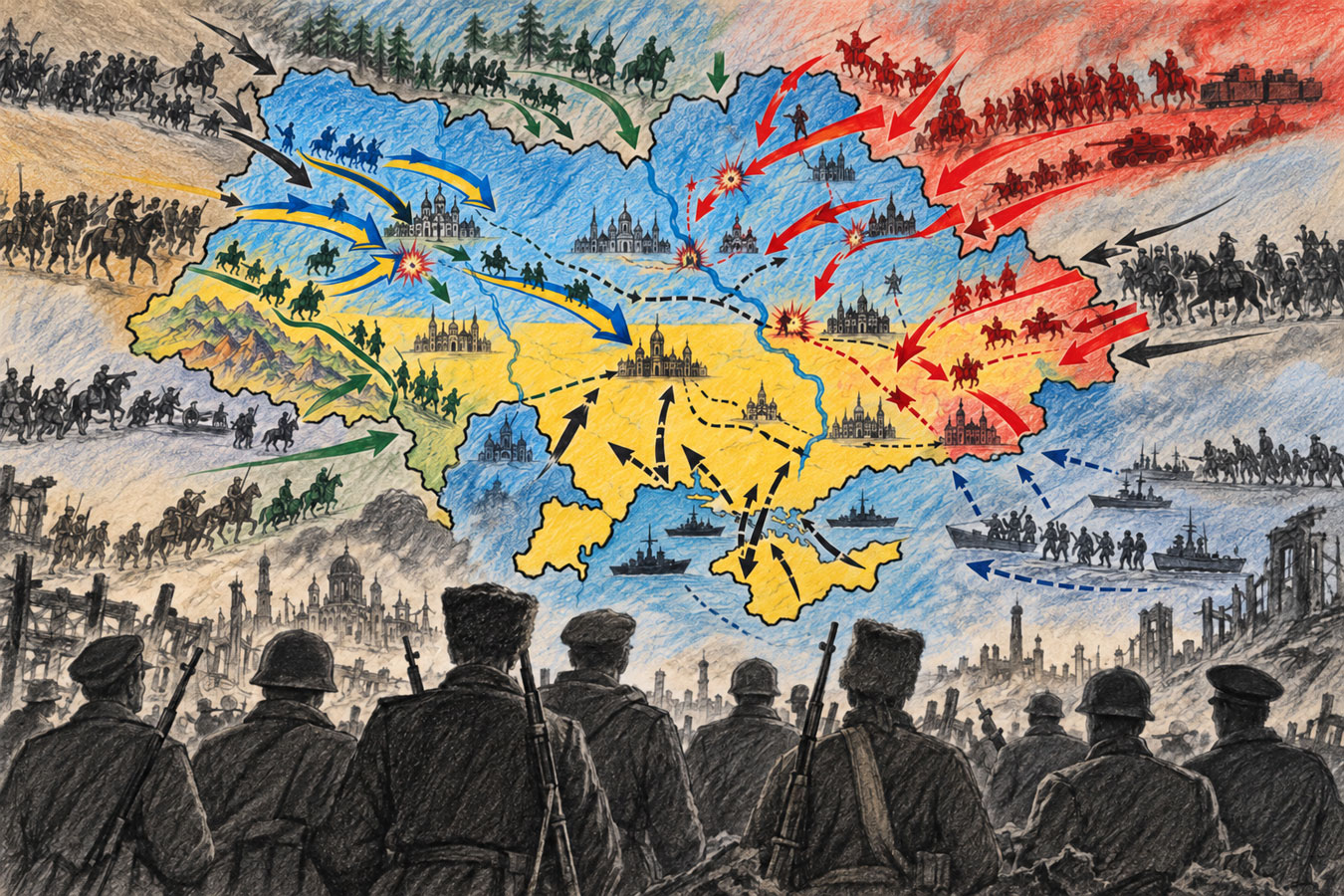
1917: When Jewish Servicemen Began to Organize
After the collapse of the Russian Empire, the Ukrainian Central Rada emerged in Kyiv as the political body that laid the foundations of the Ukrainian People’s Republic (UPR).
Jewish political parties gained representation in Ukrainian government institutions. In January 1918, the Central Rada adopted a law on national-personal autonomy, granting national communities the right to organize their cultural and public life independently.
For Jews who had endured decades of restrictions under the Russian Empire, this marked a substantial political change.
But those political promises came amid the disintegration of the army, revolution, and armed conflict. Demobilized soldiers and detachments loyal to various parties and independent commanders moved from town to town.
Jewish servicemen who had fought in the First World War began forming their own organizations. Unions of Jewish soldiers appeared, conferences were held, and plans for national military units were discussed.
Odesa became one of the centers of this movement in southern Ukraine.
Odesa: 500 Rifles, 24,000 Cartridges, and the First Jewish Battalion
The history of the 1st Jewish Infantry Battalion began in December 1917, when Jewish military organizations in Odesa proposed establishing national military units to the authorities of the Ukrainian People’s Republic (UPR). The initiative was supported by General Yelchaninov, head of the Odesa Military District, and Lieutenant Colonel Poplavko, a representative of the Ukrainian Central Rada. Poplavko conveyed the proposal to Kyiv, where the Central Rada was based under Mykhailo Hrushevsky. Jewish servicemen’s representatives also traveled there for negotiations.
On December 29, a congress of Jewish soldiers and officers in Odesa resolved to begin forming national units and established an organization called “Evrida”. Its 15-member executive committee was chaired by military physician Grigory Zhalkovsky. The organization brought together Jewish servicemen from the former Russian army, including First World War veterans, and planned to establish units not only in Odesa but also in Katerynoslav (present-day Dnipro), Mykolaiv, Simferopol, Huliaipole, and among soldiers of the former Romanian Front.
On February 13, 1918, Evrida’s leadership issued Order No. 1 establishing the 1st Jewish Infantry Battalion in Odesa. The order cited permission granted by the Ukrainian Central Rada on January 2, 1918, to form Jewish national military units. The complete text of that permission has not been found, so it remains unknown whether it applied throughout the UPR or only to petitions from Odesa organizations. It was Evrida itself, rather than the Ukrainian military ministry, that issued the February order establishing this particular battalion.
By then, the Bolsheviks had taken control of Odesa and proclaimed the Odesa Soviet Republic. Nevertheless, the new formation retained an independent command, belonged neither to the Red Army nor to the regular UPR army, and anticipated further cooperation with the Ukrainian authorities.
Former Russian army ensign Moses Usiskin was appointed commander, Boris Bogdanov his deputy, and Gabriel Gershenkroyn chief of staff. A military official named Steinberg took charge of supplies on February 15. The next day the first 20 volunteers arrived under Froim Cherkes, who became commander of the first infantry company.
On February 18, the battalion received 500 rifles and 24,000 cartridges from a base depot of the former Russian army’s Romanian Front. At the time, Mikhail Muravyov commanded the forces of the Romanian Front and the Odesa Red Army. The published documents, however, do not identify who specifically authorized the release of the weapons. The precise location of the depot is also unknown.
The battalion’s barracks were at 1 Prokhorivska Street, where the servicemen lived, trained, and performed guard duty.
Despite the sizable weapons shipment, the battalion itself remained relatively small. According to historian O. M. Sholk, it numbered around 240 enlisted men, or fewer than 300 personnel including officers. Its strength changed continually as volunteers arrived and others were discharged or deserted.
Most personnel were Jewish former Russian army soldiers, First World War veterans, university students, secondary-school pupils, and military-school graduates. Its exact ethnic composition has not been established, so the presence of servicemen of other nationalities cannot be ruled out.
Volunteers included Iosakhar Violin from Ufa; Yakov Pesis, a graduate of the Zhytomyr school for ensigns; Usher Tutkovsky, who graduated from a military school in Peterhof; and Iosif Rosenblit, a graduate of the Chuhuiv military academy. Many officers held Zionist views and supported the establishment of a Jewish national home in Eretz Israel, the historic Land of Israel.
Contemporary Odesa newspapers claimed that the unit included 120 recipients of the St. George Cross, an award for bravery in the Russian army. However, no complete roll of these decorated soldiers has been found, and the reported number remains unconfirmed.
On March 4, on the orders of Odesa’s Soviet commandant, Borovoy, the battalion began guarding municipal facilities, including an arms arsenal.
On March 9, a second infantry company began forming under Boris Bogdanov. Shafir, Violin, and Usievich were appointed instructors. A machine-gun platoon was also being organized under instructor Zinkov. The battalion had no separate cavalry or artillery units.
Administrative and medical services operated at headquarters. Grigory Zhalkovsky served as military doctor, Rogozovsky as treasurer, Drozdin as administrative clerk, and Gorbaty as quartermaster.
Daily service included drill, marksmanship training, guard duty, and strict discipline. Soldiers could attend a synagogue during their free time, but men who refused orders were expelled from the unit.
In an order dated March 11, Moses Usiskin expressly emphasized that the battalion must protect not just the Jewish population but the safety of all Odesa residents, regardless of nationality.
That requirement soon became practical. Between March 13 and 15, 1918, as the Bolsheviks withdrew from Odesa but Ukrainian and Austro-Hungarian troops had yet to establish control, there was a threat of widespread looting.
Together with volunteer militias and the city police, the Jewish battalion guarded Moldavanka, residential neighborhoods, markets, the state bank, treasury, and telephone exchange. At the initiative of the city authorities, the artillery arsenal supplied the unit with four Maxim machine guns, eight spare barrels, and 100 hand grenades.
Ukrainian and Austro-Hungarian troops entered Odesa on March 15, after which UPR representatives returned to power. The battalion’s leadership now saw an opportunity to secure formal incorporation into the Ukrainian army.
On March 18, the battalion introduced new insignia: instead of armbands, servicemen were to wear caps with white-and-blue bands and a Star of David in place of the military cockade.
That same day, Evrida leadership representative Kh. L. Averbukh and chief of staff Gabriel Gershenkroyn went to Kyiv for talks with the UPR military ministry.
The negotiations failed. Austro-Hungarian commanders and Ukrainian military authorities opposed the continued existence of independently established armed formations outside the UPR army’s prescribed structure.
The UPR’s chief commissioner for Kherson, Katerynoslav, and Tavriia governorates, Semyon Komorny, ordered the battalion’s demobilization.
Discharges began on March 24. The last to be demobilized, on April 7, 1918, were Moses Usiskin, Gabriel Gershenkroyn, Boris Bogdanov, and several other officers.
Thus ended the almost two-month history of Odesa’s 1st Jewish Infantry Battalion.
It never became part of the regular Ukrainian army, but it arose through the initiative of Jewish servicemen supported by representatives of the Ukrainian Central Rada. Its organizers sought cooperation with the Ukrainian authorities, while its soldiers protected not only Jewish neighborhoods but also institutions serving the entire city during the March power vacuum.
For Ukrainian-Jewish history, this is a little-known, documented example of cooperation in which the establishment of a national military unit went hand in hand with the defense of all Odesa residents.
Mikhail Dashevsky and Odesa’s Jewish Militias: From 50 Volunteers to Defending Towns Across Ukraine
Even before the 1st Jewish Infantry Battalion was created, another armed organization appeared in Odesa: the Jewish Fighting Militia, intended to protect residents from pogroms and looting. Its formation began on December 4, 1917, at the initiative of the local Jewish Military Organization (JMO), headed by former military official Haskel Averbukh.
The militia’s creation followed an incident involving Ukrainian soldiers. In early December, while carrying out an order to disarm non-Ukrainian units of the former Russian army, soldiers acting for the Ukrainian Central Rada demanded that JMO members assembled at 73 Uspenska Street surrender their weapons. The organization had already declared its neutrality; its leaders complied but lodged a protest with the Ukrainian authorities. On instructions from the Central Rada’s representative in Odesa, the weapons were returned to the Jewish servicemen. Volunteer enlistment in the militia then began.
Its military organizer and commander was 24-year-old ensign Mikhail (Moses) Markovich Dashevsky, who later also headed its staff. At first the militia had about 50 armed fighters, although some newspapers were already reporting 1,500 recruits. Historian Yaroslav Tynchenko regards those press figures as greatly exaggerated.
The militia was distinct from the regular-style Jewish battalion established by Evrida in February 1918. It was a volunteer self-defense organization that belonged neither to the UPR’s regular army nor to the Red Army.
Over time, the organization acquired headquarters, standing patrols, and its own funding. Headquarters were initially in Barabash’s house at 42 Velyka Arnautska Street, at the corner of Rishelievska Street, and later moved to 42 Rishelievska Street.
Funds were collected from Odesa’s Jewish residents. The finance committee was headed by M. A. Galperin, with Bronstein as treasurer; Lukashevker, Fridmak, and Bein served on its audit commission. Building committees proposed contributing part of residential rents to support the militiamen.
But Dashevsky’s activities soon extended far beyond Odesa.
By January 1918, headquarters was receiving requests for armed assistance from Jewish communities in other towns. Reports from Chechelnyk warned of an impending pogrom; from Rybnitsa came reports of three attacks that had already taken place.
35 volunteers were sent to Chechelnyk, and 50 to Rybnitsa. Military instructors traveled to Holta, Olviopol, and Bohopil to help residents organize their own self-defense. Other instructors were already working in Holovanivsk, Rudnytsia, and Kodyma.
Detachments were later sent to Rashkov, Kryve Ozero, and Dubossary as well. Fifty fighters went to Kryve Ozero, and another 50 were planned for Rashkov. Militiamen were active in Krutne, Birzula, and other towns of the Podolia and Kherson governorates, historical administrative regions encompassing much of today’s central and southern Ukraine and neighboring territories.
Events were especially difficult in Dubossary, a city on the Dniester now located in Moldova’s unrecognized Transnistria region.
Attacks on its Jewish population accompanied the movement of demobilized soldiers from the former Russian army. When local self-defense could not stop the pogrom, the community appealed to Odesa for help.
Dashevsky’s headquarters dispatched 26 armed volunteers. One of the detachments was commanded by ensign Geld.
The militiamen initially attempted to negotiate an end to the violence with the attackers. Gunfights followed.
In one clash, volunteer Malkus was wounded when a grenade was thrown at him. Three other fighters were wounded later: Weinberg, Odessky, and Titievsky.
Grigory Kotovsky, who would later become a prominent Red Army commander, also tried to negotiate. He had arrived in Dubossary with troops of the 6th Army, but his mediation failed to end the attacks.
The contemporary Odesa press preserved an unusual detail: a local communal rabbi, dressed in a soldier’s uniform, joined the defenders. Without a weapon, he threw stones at the attackers.
The militiamen also detained people who had looted the home of an Orthodox priest. They defended public order, not merely the property of the Jewish community.
By late January, the situation in Dubossary had become relatively calm. Some of the detachment returned to Odesa, while 14 volunteers remained at the request of local residents.
Relations with the various armed authorities were often difficult. In January 1918, during fighting between Ukrainian and Bolshevik forces in Odesa, Ukrainian troops detained approximately 45–50 members of the Jewish Military Organization, mistakenly believing them to be enemies. They were released once the circumstances had been clarified.
In other towns, the volunteers benefited from documents issued both by Soviet bodies and by Ukrainian Central Rada representatives. In Rudnytsia and Birzula, for example, Ukrainian soldiers initially tried to disarm Jewish detachments but desisted when shown Ukrainian credentials certifying that the volunteers had been sent solely to prevent pogroms.
The militia also performed guard duty within Odesa, patrolling neighborhoods, assisting building committees, and apprehending robbers. There were casualties. On January 25, 1918, 19-year-old Abram Yanishevsky died in an accidental weapons incident; in early February, militiaman I. Epstein was killed in a gunfight with robbers.
When Ukrainian and Austro-Hungarian troops returned to Odesa in March 1918, the militia tried to retain its status as a city guard. But the Austro-Hungarian military commandant, Rudolf von Braun, ordered all independently organized armed formations to disarm. By noon on March 20, the militiamen had surrendered their weapons, although memoirs suggest that some arms were hidden.
The organization resumed its activities in November 1918, after Germany and Austria-Hungary’s defeat in the First World War. Haskel Averbukh and Mikhail Dashevsky again led it.
During December fighting in Odesa between supporters of the UPR Directory—the Ukrainian government that succeeded Hetman Pavlo Skoropadsky—and White Army formations, the volunteers continued guarding the city.
Their work won the recognition of municipal authorities. On January 10, 1919, militia representative Dr. E. G. Raukhverger proposed allocating 30,000 rubles from the municipal treasury to maintain the organization. The initiative was supported by mayor M. V. Braikevich, who emphasized the Jewish self-defense force’s service to Odesa. The city council approved the funding.
The money was used to expand a network of guard posts equipped with telephones. In the event of an attack, residents could call a nearby post, which would dispatch a patrol.
On February 25, 1919, during a National Day of Mourning for victims of anti-Jewish pogroms in Ukraine, the militia mobilized several hundred reservists and stepped up security in Odesa, particularly in Moldavanka. Its actions were coordinated with armed student detachments.
Historian Ilya Cherikover’s memoirs suggest that by spring 1918 the militia allegedly had 600 full-time fighters, twelve barracks, 22 machine guns, and 1,000 rifles. Yaroslav Tynchenko, however, considers these figures significantly inflated. No reliable complete personnel register has been found to substantiate them.
The Red Army recaptured Odesa in April 1919. On the orders of its new garrison commander, Yurii Tiutiunnyk, the independent Jewish militia was disarmed and dissolved.
The Bolsheviks established their own 1st Jewish Workers’ Militia of the Red Army under Z. D. Pogorelsky. By April 10, it numbered about 300 personnel, including a medical unit, and comprised four platoons. In May it was reorganized into the Odesa Jewish Reserve Battalion. This was a different Soviet formation, not Dashevsky’s original militia.
In August 1919, as the Bolsheviks began evacuating Odesa ahead of a White Army offensive, the city council once again authorized the restoration of Jewish self-defense. The volunteers resumed patrols and prevented attempts at looting.
But after White forces occupied the city on August 23, 1919, the situation changed. The following day, acting Odesa garrison commander Colonel Baranovsky ordered armed units that had existed under the previous authorities, including the Jewish militia, disbanded.
City and Jewish community representatives tried to preserve it. But White general Yakov Shilling, commanding forces in the Odesa area, declared he saw no need for separate Jewish units. The city commandant, Colonel Mogilevsky, supported his stance.
A few weeks later, Dashevsky himself was killed.
On September 13, 1919, the 25-year-old former militia commander was murdered near the village of Burlacha Balka outside Odesa.
Dashevsky, who was also interested in the natural sciences, was then employed at a biological research station in Lustdorf studying fish. According to contemporary newspaper reports, unknown armed men detained him and his companions near the village of Olhyne while they were traveling to his workplace.
His companions were subsequently released, but Dashevsky was kept in custody. Local villagers later told his father that they had discovered a body in the bushes. His father identified it as his son.
Exactly who murdered Dashevsky, and why, has never been conclusively established. Contemporaries noted that he had publicly broken with a Jewish socialist party when it adopted communist positions.
Mikhail Dashevsky was buried on September 14, 1919, at Odesa’s Second Jewish Cemetery. Obituaries were published by his parents, former fellow servicemen, militiamen, and representatives of Jewish public organizations.
Beginning with a few dozen volunteers, Odesa’s Jewish self-defense developed over less than two years into an organization that residents of towns across several governorates turned to for assistance. Its fighters operated under repeatedly changing governments, cooperated with Ukrainian representatives, received municipal funding, and guarded not only Jewish neighborhoods but also institutions serving the entire city.
The story of Mikhail Dashevsky and his comrades is another little-known chapter of Ukrainian-Jewish cooperation, where national self-organization went hand in hand with responsibility for neighbors’ safety, regardless of origin.
Lviv: Armed Neutrality
On November 1, 1918, fighting broke out in Lviv between Ukrainian and Polish armed formations. Following the collapse of the Austro-Hungarian Empire, both sides laid claim to Eastern Galicia, a historical region much of which now lies in western Ukraine.
On the night of November 1, Ukrainian soldiers of the former Austro-Hungarian army occupied Lviv’s key institutions, raised a blue-and-yellow flag above the city hall, and announced the establishment of Ukrainian authority. These events became known as the November Uprising, or *Lystopadovyi zryv*. On November 13, the new state officially took the name West Ukrainian People’s Republic (WUPR).
Its governing body was the Ukrainian National Council, while its armed forces would become known as the Ukrainian Galician Army (UGA). It was a separate Ukrainian state formed on former Austro-Hungarian territory, not a unit of the Ukrainian People’s Republic based in Kyiv.
Lviv was then a multiethnic city. Poles made up more than half its inhabitants, Jews around one-quarter, and Ukrainians a smaller proportion. As Polish armed formations resisted Ukrainian rule, large parts of the city lay between the opposing sides’ positions.
Lviv’s Jewish political organizations declared neutrality, but concluded that maintaining it required an armed guard of their own.
Israel Waldman, Juliusz Eisler, and the Creation of the Militia
One organizer of Jewish self-defense was Israel Waldman, a doctor, former Austro-Hungarian army captain, and Zionist activist. Shortly before the November events, Zionist circles had sent him from Vienna to Lviv to arrange protection for the Jewish population should armed conflict erupt.
Together with another Jewish officer, Captain Juliusz Eisler, Waldman helped establish the Jewish Security Committee, which brought together local Jewish political and civic organizations.
On November 1, 1918, the committee began forming the Lviv Jewish Militia. Its core consisted of former Austro-Hungarian soldiers and officers of Jewish origin. Eisler exercised direct military command.
The force was intended to guard Jewish neighborhoods, synagogues, shops, and homes, and to maintain order in the streets. It belonged to neither the Polish nor the Ukrainian army and was not officially supposed to participate in the struggle for the city.
The Ukrainian command agreed to the unit’s creation. Indeed, it told Jewish community representatives that amid street fighting it could not guarantee the safety of every Jewish neighborhood and suggested that the community organize its own armed protection.
Cooperation was established between the Ukrainian military and the Jewish Security Committee. The Ukrainian side supplied the militiamen with weapons and uniforms, while Jewish commanders coordinated patrol areas and reported personnel strength to Ukrainian military headquarters.
The militia nevertheless retained its own leaders and independent tasks.
37 Officers, 237 Riflemen, and Five Permanent Posts
Unlike many other Jewish volunteer organizations of the period, the Lviv militia’s strength can be reconstructed from the surviving daily reports of the Ukrainian military command.
On November 6, it had 24 officers and 206 riflemen. On November 7, 24 officers and 195 riflemen. By November 10, its strength had risen to 35 officers and 238 riflemen; on November 12, to 42 officers and 237 riflemen.
On November 13, 1918, the militia had 37 officers and 237 riflemen, for a total of 274 servicemen.
This is its documented strength on a particular date, not the overall number of people who ever served in it. Higher estimates also appear in memoirs, but the archival reports provide a more precise picture of changing strength.
The Ukrainian command and Jewish Security Committee agreed on the locations of five permanent guard posts. They stood near the Reformers’ Synagogue on Staryi Rynok Square; the synagogue on Bozhnycha Street (now Sianska Street); and at 25 Zholkiievskoho Street, 25 Bliakharska Street (now Ivan Fedorov Street), and 25 Riznytska Street (now Severyn Nalyvaiko Street).
Jewish patrols also operated in Lviv’s Krakivske, Zhovkivske, Kleparivske, and Yanivske suburbs.
On November 8, the Ukrainian command issued a special order defining the militia’s areas of operation. They also included Boimiv, Serbska, Valova, and surrounding lanes.
On November 11, a new order clarified the patrol boundaries, expressly emphasizing that the militia remained neutral but armed.
These arrangements were needed to prevent accidental confrontations between Ukrainian units and Jewish patrols, and to ensure that neither interfered with the other’s duties.
Militiamen wore armbands on their left arms bearing Zionist symbols. They sometimes patrolled alongside Ukrainian servicemen.
On November 14, the Ukrainian command received reports of unidentified armed men passing themselves off as Jewish militiamen in the Lychakiv suburb. It ordered the impostors detained. That same day, militia leaders introduced new pink identity documents bearing inscriptions in Yiddish and invalidated the earlier permits.
Such details have survived because orders concerning the Jewish militia were incorporated into the Ukrainian military authorities’ official orders.
Ukrainian Commanders, Polish Troops, and the Problem of Neutrality
The militia’s relations with Polish armed groups proved far more difficult.
In early November, Jewish representatives obtained preliminary acknowledgment of neutrality from both sides. On November 9, a separate agreement was concluded with Polish commanders, recognizing the militia’s right to operate in designated city districts.
But the agreements were not always honored in practice.
Polish servicemen entered Jewish neighborhoods, while the militiamen attempted to prevent armed attacks and looting. Exchanges of gunfire followed.
The Polish commander of Lviv’s defense, Czesław Mączyński, later claimed that the Jewish militia had repeatedly fired on Polish patrols. At the same time, he acknowledged that he knew of no instances of its armed resistance to Ukrainian units.
Jewish leaders continued to insist on their neutrality and explained the clashes as necessary to protect their neighborhoods from armed men.
A revealing incident occurred on the night of November 13–14. A patrol led by Moshe Olmyuts detained three armed Poles, one of them reportedly a known criminal. They were released following the intervention of a Polish officer, but soon afterward Olmyuts and eleven of his comrades were themselves arrested.
On November 17, seven Jewish militiamen carrying a white flag tried to reach Polish positions to coordinate action against looters. They were fired upon despite the white flag. One volunteer was killed; the others were detained and beaten.
There were also disputes with individual Ukrainian servicemen. On November 16, for example, the Jewish militia reported to Ukrainian headquarters that four men from a Ukrainian patrol had allegedly robbed a clothing shop at 18 Shpytalna Street. On November 17, the Ukrainian command ordered an investigation to determine whether the attackers really belonged to its units.
That episode matters: the Jewish militia could formally complain about the conduct of Ukrainian soldiers to their commanders and obtain an order to investigate.
A Telegram to the U.S. President
By mid-November, tensions between the Jewish community and Polish military forces had intensified.
According to the Jewish Security Committee, Polish formations had begun forcibly mobilizing Jewish men to fight against Ukrainians.
On November 14, Israel Waldman and Juliusz Eisler sent a telegram to U.S. President Woodrow Wilson and the Copenhagen Zionist Bureau, one of the international centers of the Zionist movement at the time.
They reported bloody fighting in Lviv, reaffirmed the neutrality of Eastern Galicia’s Jewish population, and protested against the forced recruitment of Jews to fight on the Polish side.
Their appeal to the American president had particular significance: after the First World War, Wilson advocated the principle of national self-determination, and the borders of Europe’s new states were still to be settled.
Jewish representatives sought international recognition of their communities’ right to stay out of the Polish-Ukrainian conflict.
On November 20, a Provisional Jewish National Council was formed in Lviv, bringing together Zionists, Jewish Social Democrats, the religious Mizrahi movement, and the socialist Poale Zion movement. It sent a memorandum to the Ukrainian and Polish sides declaring itself the representative body of the city’s Jewish population.
The military situation, however, was already changing rapidly.
November 1918: The Fall of Lviv and the Tragedy of Its Jewish Neighborhoods
On the night of November 21–22, 1918, Ukrainian troops withdrew from Lviv, unable to withstand an offensive by Polish forces that had received reinforcements.
Some Jewish volunteers, predominantly former Austro-Hungarian officers, departed with the Ukrainian units. Most militiamen remained in the city.
After Polish forces established control, the Jewish militia was disarmed and some of its leaders arrested. An anti-Jewish pogrom began, lasting from November 22 to 24.
Polish soldiers and civilian participants looted Jewish houses and shops, damaged religious institutions, and assaulted and killed people.
Historical studies offer different casualty figures. Yaroslav Tynchenko cites Jewish historians’ figures of 73 killed and 463 wounded. Other investigations give somewhat different estimates, but extensive testimony confirms both the scale of the violence and the involvement of armed Polish men.
Accusations against Jews included claims that the militia had collaborated with the Ukrainians. Yet Jewish organizations had officially maintained neutrality, and individual exchanges of fire between militiamen and Polish patrols do not justify treating the entire community as a party to the war.
The pogrom’s victims were buried in late November. One veteran of the Galician Army recalled former Jewish Austro-Hungarian officers carrying coffins, including one containing a charred Torah scroll.
Some memoirs also claim that militia organizer Juliusz Eisler was killed in the street fighting, although the precise circumstances of his death have not been firmly established.
What Happened to the Jewish Volunteers After November
The Lviv militia ceased to exist as an independent armed formation. Some of its former members were persecuted on charges of collaborating with Ukrainians.
Some officers and volunteers joined Ukrainian forces continuing the fight outside the city. Galician Army veterans’ memoirs mention Jewish students and former militiamen who voluntarily enlisted in Ukrainian units.
Tynchenko cites an account of a Jewish volunteer who became a khorunzhyi—a junior Ukrainian army officer—and was later captured by Polish troops during fighting near Belz or Rava-Ruska.
It would nevertheless be wrong to suggest that the entire Lviv militia joined the Ukrainian Galician Army. The organization had been established to protect civilians, and most of its members never became UGA servicemen.
Israel Waldman continued his political work and cooperation with the Ukrainian national movement. On October 8, 1922, in Vienna, the exiled WUPR leader Yevhen Petrushevych appointed him commissioner for the Jewish population of Eastern Galicia.
In 1924, Waldman addressed Galicia’s Jews, linking the prospects for their political and economic emancipation with Ukrainians’ struggle for national rights.
Armed Jewish militias also existed in Ternopil, Kolomyia, Pidvolochysk, and other Galician towns. They generally remained neutral, although some members later voluntarily entered Ukrainian military service.
The story of the Lviv militia is not that of a Jewish unit within the Ukrainian army. It was an independent armed force established by the Jewish community to guard its neighborhoods. But it operated with the formal recognition of Ukrainian authorities, who supplied weapons and uniforms and coordinated guard duties.
That practical cooperation between Ukrainian soldiers and Jewish volunteers was one of the little-known chapters in the two peoples’ shared history. For some participants, it continued after the Ukrainian defeat in Lviv, through service in the Galician Army and political activity abroad.
Salko Rottenberg: Eight Machine Guns and Two Violins
In May 1919, an unusual military unit appeared in the 4th Zolochiv Brigade of the Ukrainian Galician Army (UGA): a mounted machine-gun company in which approximately half the servicemen were Jewish and the other half Ukrainian. It was commanded by Salko (Solomon) Rottenberg, a Jewish career soldier.
Rottenberg was born on August 14, 1894, in the village of Piatnychany, Stryi district, in what is now Ukraine’s Lviv region. During the First World War, he served in the Austro-Hungarian army’s 77th Infantry Regiment, a significant proportion of whose soldiers were Ukrainians from the Sambir area of Galicia.
After Austria-Hungary collapsed, Rottenberg joined the Ukrainian national movement. Historian Oleh Stetsyshyn reports that he arrived from Vienna with a group of 17 Ukrainian officers. According to military historian Yaroslav Tynchenko, he entered the Galician Army on November 27, 1918, initially serving in the Vostok (“East”) combat group and taking part in fighting against Polish forces for Lviv while commanding Ukrainian servicemen from the Sambir region.
Historical publications also describe Rottenberg as a former officer of the Lviv Jewish Militia, which had guarded Jewish neighborhoods during the November battles.
By spring 1919, he was serving in the 4th Zolochiv Brigade of the UGA’s II Corps, part of the regular army of the West Ukrainian People’s Republic (WUPR), formed following Austria-Hungary’s collapse. The brigade had been formed in January 1919 from the Vostok combat group. It included four infantry *kurins*, or battalion-level units, and two artillery regiments.
Many Jews served in the brigade. Tynchenko writes that they made up more than half of its medical personnel and also served as machine gunners and riflemen. Rottenberg already commanded an infantry company, holding the rank of chetar, a junior Galician Army officer rank roughly equivalent to lieutenant.
In early May, Colonel Stepan Chmelyk assumed command of the brigade. Amid continuing fighting with Polish troops, he ordered the formation of a mobile machine-gun unit capable of providing rapid infantry support and covering a withdrawal.
The task of organizing the company was entrusted to Rottenberg in mid-May because of his machine-gun experience. He gathered Jewish soldiers from different brigade units and brought them together with Ukrainian fighters, creating a mixed formation of approximately equal ethnic composition. Its exact personnel strength has not been established from the surviving accounts.
The second officer was chetar Volodymyr Mykhailiv, also a First World War veteran. His later memoirs preserve details of Rottenberg’s final battles.
The company’s armament consisted of eight machine guns. Each was transported on a light, two-wheeled, single-horse cart. Machine-gun crews rode on horseback, while spare ammunition belts were carried on additional carts.
This arrangement allowed the company to change positions quickly, move firepower between sectors of the front, and cover infantry during both advances and retreats.
Brigade veteran Stepan Haiduchok recalled that the company was created in a matter of days: the command acquired horses, carts, and machine guns, and Rottenberg assembled and organized the personnel.
Haiduchok described it as an excellent fighting unit. He had particularly high praise for the commander, who had been wounded earlier that winter but returned to the front after recovering. In the Ukrainian officer’s memoirs, Rottenberg is called “a Ukrainian Jew”, meaning a man of Jewish origin consciously serving the Ukrainian cause.
The company had one especially unusual feature.
Three musicians rode at the head of the unit on the march, two of them playing violins. Haiduchok did not identify the third instrument. The musicians accompanied the company’s movements, and the soldiers sang marching songs.
When the order to fight came, the music stopped. The machine gunners dismounted, unloaded their weapons, took up positions, and opened fire.
Haiduchok described this scene in detail in his memoir “Kinna skorostrilna sotnia” (“Mounted Machine-Gun Company”), published in 1930.
Rottenberg’s mounted machine-gun company fought the Polish army in Eastern Galicia. In June 1919, the 4th Zolochiv Brigade took part in the Chortkiv Offensive, a Ukrainian counteroffensive in which troops made gains around Chortkiv, Terebovlia, Berezhany, and Pomoriany.
In July, under Polish pressure, the Galician Army retreated across the Zbruch River, a historic border between former Austro-Hungarian and Russian territories. Its units then fought the Bolsheviks in central Ukraine alongside the army of the Ukrainian People’s Republic, whose government had been based in Kyiv before Soviet troops took the city.
The 4th Zolochiv Brigade took part in offensives toward Proskuriv (today Khmelnytskyi), Starokostiantyniv, Shepetivka, Zhytomyr, and Korosten.
The company faced its most difficult fighting near Korosten in Zhytomyr region in early September 1919.
According to Volodymyr Mykhailiv’s memoirs, the 4th Brigade’s 8th Infantry Regiment was advancing toward Korosten from the east, along the railway to Kyiv. A battalion commanded by Captain Pavlo Ivanov repeatedly tried to break through Bolshevik positions but was forced back each time with casualties under artillery and machine-gun fire.
After the failed attacks, Ivanov ordered Rottenberg to send forward the mounted machine-gun company, which had been temporarily assigned to his battalion.
Rottenberg questioned whether a small mobile unit could advance where the infantry had failed, but obeyed the order.
The machine-gun carts moved toward Korosten’s eastern outskirts. The soldiers unloaded their weapons and opened fire, gradually forcing the Bolsheviks out of the first houses.
Rottenberg himself remained among the machine-gun crews, riding between positions on horseback and directing their fire.
The enemy soon received reinforcements. Under intensifying artillery and machine-gun fire, the company had to withdraw.
Two machine guns continued holding back the Bolsheviks while the other soldiers evacuated the wounded on carts.
Many members of the unit were killed in the fighting, including all three musicians who had accompanied the company since its formation.
On September 4, 1919, Rottenberg was severely wounded in the face. A bullet knocked out his teeth and lodged in his neck.
Command of the remaining company passed to chetar Bodnar, while the wounded Rottenberg, his head bandaged, was evacuated with the baggage train.
That day, the entire II Corps of the Ukrainian Galician Army was retreating from Korosten. The company suffered such serious losses that, Tynchenko suggests, it was probably later disbanded as an independent unit.
Rottenberg was taken first to Zhytomyr, then to Proskuriv, and finally to a hospital in Kamianets-Podilskyi.
According to information later received by Mykhailiv, the hospital lacked an X-ray machine needed to locate the lodged bullet. Blood poisoning was reportedly developing.
In memoirs published in the journal *Ukrainskyi Skytalets* in 1922, Mykhailiv wrote that he had heard Rottenberg had died in Kamianets-Podilskyi. But he had not witnessed his commander’s death and expressly noted that the report was based on hearsay.
Historical works therefore generally state that Salko Rottenberg died of complications from his wound in Kamianets-Podilskyi, probably in 1919, although the exact date and documented circumstances of his death remain unknown.
Volodymyr Mykhailiv remembered his comrade as a man faithful to his military duty and to Ukrainian independence. He ended his account by calling Rottenberg a patriot and defender of Ukraine.
The company’s story is particularly striking in Ukrainian-Jewish relations. A Jewish officer commanded both Ukrainian and Jewish servicemen; a Ukrainian colonel entrusted him with the formation of a combat unit; and years later, his comrades preserved the memory of their commander and his soldiers.
Eight machine guns, light horse-drawn carts, two violins, and service together on the Ukrainian front: the details of this small military unit make it one of the documented examples of Ukrainian-Jewish comradeship in arms.
The Hutsul Battalion: Eight Jewish Graves Near Pidkamin
In summer 1919, a separate detachment of more than 80 Jewish volunteers appeared within the 1st Hutsul Assault Battalion of the Ukrainian Galician Army (UGA). They fought alongside Ukrainian soldiers against Polish troops. Their participation was recorded by the battalion’s commander, Hryhorii (Hryts) Vasylovych Holynsky-Hurbych.
The Hutsul Battalion had been established in November 1918 in Kolomyia, in today’s Ivano-Frankivsk region of Ukraine. It drew primarily on volunteers from Hutsulshchyna—a Carpathian area inhabited mainly by the Hutsuls, a Ukrainian ethnocultural group—and former Austro-Hungarian servicemen.
A *kurin* was roughly equivalent to an infantry battalion, while “assault” meant that its fighters were deployed in especially important sectors of the front. In its first months, encyclopedic sources estimate that it numbered about 1,200 servicemen, organized into four companies and a technical unit. That figure refers to the entire battalion during its initial formation, not to the Jewish detachment that joined it later.
Commander Holynsky was born on March 19, 1895, in the village of Vyzhnii Bereziv, in the Carpathian foothills. During the First World War, he served in the Ukrainian Sich Riflemen, a Ukrainian volunteer formation within the Austro-Hungarian army. After the empire’s collapse, he took part in establishing the armed forces of the West Ukrainian People’s Republic (WUPR).
The Hutsul Battalion distinguished itself in fighting against the Polish army for Horodok, Vovchukhy, and other Galician settlements. During the Chortkiv Offensive in June 1919, when Ukrainian forces launched a counteroffensive, the unit suffered heavy losses and accepted new volunteers.
It was then that Jews began joining its ranks.
Holynsky’s memoirs state that many Jewish volunteers had already experienced persecution during the Polish-Ukrainian conflict or had heard about the anti-Jewish pogrom in Lviv in November 1918. According to the commander, this influenced their decision to join the Ukrainian army.
As the battalion moved through Podolia toward Rohatyn, the number of Jewish volunteers rose above 80. At their own request, they formed a separate fighting detachment while remaining under Ukrainian command.
Their immediate commander was a senior *desiatnyk*, identified by Holynsky only by the initial “A.” This was a junior noncommissioned rank in the Galician Army, roughly equivalent to an NCO. His full name is absent from the published testimony.
One of the Jewish volunteers’ hardest battles was fought for the village of Pidkamin near Rohatyn, in today’s Ivano-Frankivsk region. It should not be confused with the village of the same name in Lviv region.
According to Holynsky’s memoirs, at about 10 a.m., acting on the orders of the commander of the Galician Army’s XII Brigade, the Hutsul Battalion left Rohatyn via the village of Cherche to assist Ukrainian units that had been fighting Polish forces since early morning.
Polish troops held advantageous defensive positions on the heights before Pidkamin. They were entrenched, while the Ukrainian infantry had to advance uphill across an open slope of roughly one and a half kilometers.
The attack was difficult. Polish soldiers repeatedly tried to retreat but returned to their trenches. Holynsky reported, citing local peasants, that a Polish general positioned behind the lines personally stopped the retreating troops, even physically striking some of his officers.
To support the frontal Ukrainian assault, the Jewish detachment was ordered to move undetected around the Polish positions and attack from the rear.
The volunteers carried out the order. As the battalion’s main force advanced on the fortified heights, Jewish fighters circled around the enemy and engaged in hand-to-hand combat.
The surprise attack from behind helped break Polish defenses. The enemy began to withdraw, and Ukrainian units pursued them and occupied the village.
Holynsky particularly praised the determination of the Jewish volunteers fighting in the front ranks.
But the victory came at a high cost.
Eight Jewish servicemen of the Hutsul Battalion were killed in the battle. According to the commander’s memoirs, they were buried on a rise near the castle in Pidkamin.
Holynsky hoped that one day Ukrainian peasants and Jews would visit these graves and lay wreaths in memory of the dead.
His account was preserved in the memoir “V chetvertu richnytsiu. Zhydy, yak striltsi 1-ho udarnoho Hutsulskoho kurenia” (“On the Fourth Anniversary: Jews as Riflemen of the 1st Hutsul Assault Battalion”), later used by military historian Yaroslav Tynchenko.
The exact date of the battle is not given in the published excerpt. The eight dead men’s full names have yet to be established. Nor has the present condition of the graves near the castle mentioned by Holynsky been verified. It would therefore be wrong to assert without further research that the graves survive today.
The 1st Hutsul Battalion continued its military service. After the Galician Army retreated beyond the Zbruch River in July 1919, it took part in operations in central Ukraine, including the offensive toward Kyiv and fighting against Bolshevik and White Army forces.
Holynsky was later captured by the Poles, escaped, and continued his civic activity. After Soviet rule was established in western Ukraine, the NKVD arrested him. Hryhorii Holynsky was executed in June 1941 in Stanislav, now Ivano-Frankivsk.
The Jewish volunteers’ story survives above all thanks to this Ukrainian commander. He did not merely mention their presence in the army: he described their specific mission, the circumstances of the attack, and the deaths of eight men under his command.
More than 80 Jews voluntarily joined a Ukrainian military unit, accepted its command, and fought alongside Ukrainian soldiers in the battles for western Ukraine. Eight never returned from the fighting near Pidkamin.
Their names still need to be established. But Holynsky’s memoirs tell us where they fought, what they did, and why their Ukrainian commander considered it essential to preserve their memory.
How Many Other Jewish Companies Were There?
Historical literature also mentions a separate Jewish detachment in the 11th Stryi Brigade numbering more than 70 men.
Whether this was genuinely an independent formation is disputed. Some sources may simply be describing the Hutsul Battalion’s Jewish fighters again.
Older publications also mention a Jewish volunteer company that arrived during the Chortkiv Offensive of 1919 without officers of its own. The account is associated with the memoirs of Z. Yavorsky, but it has not been established whether this was a separate unit.
The Chortkiv Offensive was a major Ukrainian Galician Army operation in June 1919, when Ukrainian forces temporarily launched a counteroffensive against Polish troops.
The total number of Jewish UGA formations therefore cannot be established simply by adding together every mention in the memoir literature: different writers may have been describing the same people.
Solomon Leinberg: The Jewish Assault Battalion That Reached Kyiv
On June 16, 1919, the Ukrainian Galician Army (UGA) recaptured Ternopil from Polish forces. One of the first people to visit the headquarters of the I Galician Corps was Solomon Leinberg, a former Austro-Hungarian army lieutenant and commander of the local Jewish militia. He proposed forming a separate Jewish military unit to fight for the independence of western Ukraine.
Ternopil was then part of the West Ukrainian People’s Republic (WUPR), which had emerged following Austria-Hungary’s collapse in November 1918. Its forces fought Poland, which also claimed Eastern Galicia. The Ukrainian People’s Republic (UPR), based in Kyiv, had its own army, with which the Galicians would later operate jointly.
Leinberg’s proposal was not spontaneous. In November 1918, after the Polish-Ukrainian War began, a Jewish militia was organized in Ternopil to protect its inhabitants. Leinberg became its commander; he had previously been a lieutenant in the Austro-Hungarian army’s 15th Infantry Regiment.
He was born in Ternopil, graduated from the local secondary school, studied at Lviv University, and gained experience as an officer in the First World War. Many of his comrades in the 15th Regiment were Ukrainians who joined the Galician Army after the empire collapsed.
Polish troops occupied Ternopil in early June 1919. Contemporary accounts state that attacks on Jews and arrests of community figures and Zionist activists followed their entry into the city. Some detainees were executed.
According to eyewitness memoirs, the Jewish community therefore welcomed the return of Ukrainian forces with relief.
Who Authorized the Jewish Battalion?
Leinberg presented his proposal not to the local civilian administration but directly to Colonel Osyp Mykytka, commander of the Ukrainian Galician Army’s I Corps.
The initiative also enjoyed the support of Ternopil’s Jewish National Council, which represented the local Jewish community.
Mykytka knew Leinberg personally from their earlier Austro-Hungarian army service. Other Ukrainian officers vouched for his professional ability and discipline.
The colonel authorized the formation of a separate Jewish battalion within the I Galician Corps, but stipulated that Ukrainian servicemen be included.
To form the unit, the command placed an existing small Ukrainian military detachment led by Lieutenant Vovk at Leinberg’s disposal. It comprised about ten Ukrainian officers, several dozen soldiers, horses, carts, weapons, and ammunition.
Corps adjutant Captain Hnatevych instructed Vovk to organize the new unit together with Leinberg.
According to Vovk’s own memoirs, many Jewish officers initially volunteered, but significantly fewer enlisted soldiers. Ukrainian volunteers began joining at the same time.
Once preparations were complete, the I Corps command placed the unit under Lieutenant Solomon Leinberg, appointing Lieutenant Vovk as his deputy.
This was the origin of the Assault Battalion of the I Galician Corps, also known by the historical Ukrainian name “Zhydivskyi proboievyi kurin.” That expression is reproduced here as a term from early twentieth-century Ukrainian documents. *Proboievyi* meant “assault” or “breakthrough,” while a *kurin* was approximately equivalent to an infantry battalion.
Unlike the independent Jewish militias of Odesa and Lviv, this was a regular Ukrainian army unit subordinate to I Galician Corps headquarters.
Jewish and Ukrainian Officers, Four Companies, and a Radio Station of Their Own
For the completion of its formation and military training, the battalion was moved to Ostapie village near Skalat, in what is now Ternopil region.
It was there that it acquired its final organizational structure.
According to memoirs by battalion officer Helbert Nakhman, who later published a history of the unit in the journal *Ukrainskyi Skytalets*, the battalion comprised four infantry companies of 220 men each, a machine-gun company with eight machine guns and 500 rounds for each, a cavalry platoon, sappers, and telephone operators.
Leinberg was trained in electrical engineering and personally equipped a radio station that provided communications between the unit and its commanders.
The battalion maintained its own food and administrative support services, but weapons, uniforms, ammunition, funds, food, animal fodder, and military specialists came from the UGA’s I Corps.
Its officers included Jews and Ukrainians. In addition to Vovk, they included Lieutenant Lashchukevych, who commanded one company, and chetar Domanytsky, who led another. Chetar was a junior Galician Army officer rank, roughly equivalent to lieutenant.
Two Jewish officers stood out in particular.
Lev Lehrer commanded the machine-gun company, while Isaac Katz led a drill and training company. Both distinguished themselves in fighting against Polish forces and were promoted.
The commander of the UGA’s XXI Brigade described Katz as a disciplined and energetic officer who controlled his men effectively and repeatedly displayed personal courage in the face of the enemy.
The battalion’s strength remains a matter of historical debate.
Helbert Nakhman gave a figure of 1,200 servicemen, including attached instructors and Ukrainian soldiers. This number subsequently appeared in many publications, including the Encyclopedia of Ukraine.
Military historian Yaroslav Tynchenko, however, considers it inflated. He estimates that even at its strongest the battalion probably did not exceed 500 men. The 1,200 figure may have represented planned establishment strength rather than the actual number present.
The distinction matters: the battalion did indeed contain several specialist sections, but this does not establish that each was fully staffed.
July 1919: Covering the Ukrainian Army’s Retreat
On July 14, 1919, the I Corps command temporarily placed the Jewish Assault Battalion under the operational command of the UGA’s XXI Brigade.
The brigade was defending the Ternopil–Pidvolochysk sector, trying to avoid encirclement by superior Polish forces.
Leinberg’s battalion hurried from Ostapie through Malyi Khodachkiv toward Kolodiivka. On the XXI Brigade’s orders, its fighters took positions between the village and the Ternopil–Pidvolochysk road, covering the withdrawal of Ukrainian units toward Skalat.
Polish troops repeatedly attempted to break through the defenses and cut off the Ukrainian army’s route to the Zbruch River.
The battalion held its ground, then fell back to Skalat, continuing to cover the retreat of the XXI and neighboring IX Brigades.
At about three o’clock in the morning of July 15, the unit took up defensive positions around Skalat. That evening it was ordered to withdraw via Horodnytsia and Ostapie to the village of Vikno.
The battalion next held the area around Hrymailiv railway station before withdrawing toward Tovste and Trybukhivtsi.
The heaviest events unfolded on July 16–17, 1919, as Ukrainian formations completed their crossing of the Zbruch.
Leinberg was ordered to occupy Trybukhivtsi and protect the crossing from Polish troops advancing from Kopychyntsi and Husiatyn.
He left a covering force with four machine guns in the previous positions and led his main force overnight toward Trybukhivtsi.
On learning that Polish units were approaching the river crossing, he ordered the Husiatyn–Trybukhivtsi road and bridgehead fortified.
The bridge itself was entrusted to Lieutenant Maziar, together with the fourth company and two machine guns.
Polish troops attacked the bridgehead. Maziar’s company continued resisting, but was surrounded; its commander and his men were taken prisoner by the Poles.
Thanks to the rearguard, the main elements of the XXI and IX Brigades, along with their baggage trains and artillery, managed to cross the Zbruch.
At around two o’clock in the afternoon of July 17, the battalion was ordered to cross to the eastern bank and destroy the bridge behind it. Once this was done, it rejoined the XXI Brigade and continued protecting its right flank.
This became one of the Jewish battalion’s best-known actions: Jewish and Ukrainian soldiers together secured the retreat of major Galician Army formations.
From the Zbruch to Proskuriv: Fighting the Red Army
After the crossing, the Galician Army entered central Ukraine, where it continued the war against the Bolsheviks alongside the UPR’s forces.
Leinberg’s battalion moved through Smotrych and Dunaivtsi, helping cover the XXI Brigade’s right flank.
On July 24, 1919, the unit took up a defensive line near the villages of Chankiv and Zastavka. In nighttime clashes, its soldiers attacked Bolshevik outposts and captured prisoners.
After the enemy withdrew on July 26, the battalion was ordered to continue its pursuit. Its route ran through Solodkivtsi and Zinkiv toward Mykhalpil.
In early August, the battalion participated in the capture of Mykhalpil, where, according to Helbert Nakhman’s memoirs, a substantial part of the local garrison was taken prisoner after clashes with Bolshevik detachments.
The Ukrainian units resumed their advance after a short rest.
On August 6, the XXI Brigade moved north, occupying the area around Bohdanivtsi. The battalion once again guarded its right flank, fought near Medzhybizh, and occupied Holoskiv and Kopachivka.
By August 10, Bolshevik units had retreated toward Starokostiantyniv. The Jewish battalion advanced with Ukrainian formations and reached Verkhovtsi near Proskuriv, today’s Khmelnytskyi.
But the unit had already suffered significant losses.
The I Corps command ordered its removal from the XXI Brigade’s direct operational control and return to corps headquarters, then at Luka-Barska.
Its principal assignment now became guarding the corps headquarters and senior commanders.
Vinnytsia, Berdychiv, Fastiv, and Sviatoshyn Station
Together with the I Corps headquarters, the battalion moved first to Brailiv and then to Vinnytsia, where it guarded the city and military facilities.
After successful Ukrainian operations around Kalynivka and Berdychiv, the battalion was sent to Berdychiv and continued its guard duties.
In late August, after Ukrainian troops took Koziatyn and Fastiv, the I Corps headquarters and the battalion relocated to Fastiv.
On August 28, 1919, the Jewish battalion was once again placed temporarily under the operational command of the Galician Army’s VI Brigade, which was taking part in the advance on Kyiv.
The unit performed advance security duties. Some of its men were among the first to reach Kyiv’s western outskirts, occupying Sviatoshyn railway station and holding it until the general Ukrainian withdrawal.
Today Sviatoshyn is part of Kyiv, but in 1919 it was a suburban railway junction important for troop movements and supplies.
After abandoning Sviatoshyn, the battalion covered the VI Brigade’s retreat across the Irpin River, then withdrew with it via Fastiv, Popilnia, and Koziatyn toward Berdychiv.
There, on the I Corps command’s orders, it was again detached from the VI Brigade.
In Berdychiv, according to Helbert Nakhman’s memoirs, the conduct of Jewish and Ukrainian soldiers earned the local population’s trust.
Leinberg obtained permission from the city’s civilian administration to recruit Jewish young men into the battalion. The I Corps command approved the reinforcements and allotted time for rest and reorganization.
The formation was again reinforced by Jewish and Ukrainian volunteers.
One important qualification emerges from later archival research: although the memoirs continue to name Leinberg as commander, from August 1919 Galician Army documents identify the Ukrainian captain Bereziuk as the battalion’s commander.
Not every action of the formation in the second half of 1919 can therefore be automatically attributed to Leinberg’s direct command. He remained associated with the unit, but his official command and subsequent service must be distinguished.
The Ternopil Battalion: A New Name and Documented Strength
The formation’s official name also changed over time.
From August 1919, military documents referred to it as the Assault Battalion of the I Galician Corps, without any reference to Jewish national identity.
Then, on September 27, 1919, a separate Galician Army command order renamed it the Ternopil Battalion and assigned it to the VI Brigade.
This was a reorganization of an existing unit, not the creation of a new battalion from scratch.
Surviving archival records of its personnel strength are particularly important.
On October 5 and 10, 1919, the Ternopil Battalion had a total of 409 servicemen: eight officers, 45 junior commanders, 130 combatant soldiers, and 226 noncombatants.
The personnel immediately available for fighting, however, numbered only 122 men—four officers, 27 junior commanders, and 91 riflemen.
Noncombatant servicemen were responsible for supplies, transport, administration, and other support duties. The unit’s total strength was therefore not equivalent to the number of men who could immediately be sent to the front.
These records confirm that the battalion continued to exist in autumn 1919, although its organization, command, and official status had changed from the original arrangement.
The Typhus Epidemic and the End of the Unit
In autumn 1919, the Galician Army was in an exceptionally difficult position.
Battle casualties, inadequate supplies, exhaustion, and epidemics undermined its fighting capacity. Epidemic and relapsing typhus spreading among servicemen were especially dangerous.
Helbert Nakhman’s memoirs state that the epidemic killed as many as two-thirds of the Jewish battalion’s personnel. Some later publications give a figure of approximately 60 percent dead.
The actual proportion who died has not been established from documentary evidence. These figures should be treated as memoirists’ estimates, not verified mortality statistics.
By the end of 1919, only a small proportion of the former unit remained fit for duty. The battalion’s remnants were stationed near Vinnytsia, carrying out guard duties.
On November 17, 1919, the Galician Army’s leadership concluded an agreement with General Anton Denikin’s Armed Forces of South Russia. For many Jewish servicemen who had fought for Ukrainian independence, the prospect of coming under White command was unacceptable, given anti-Jewish violence perpetrated by White formations.
Some men left the army. Others headed to Odesa, hoping to emigrate to Palestine through local Jewish organizations.
Historical publications tell of a group of almost one hundred former battalion servicemen who reached Palestine by sea together with members of the Odesa Jewish militia. However, the exact passenger list, itinerary, and circumstances of that voyage require further archival confirmation.
Other veterans returned to Eastern Galicia, now under Polish control, or remained in central Ukraine.
A later document survives as well: Order No. 1 of January 24, 1920, for the I Galician Corps, under which the remnants of the Ternopil Battalion were deemed to have been transferred to the Galician Army command’s weapons and artillery group with an effective enrollment date of July 21, 1919. This retrospective administrative record should not be confused with the date when the unit actually ceased combat operations.
So ended the history of the independent Jewish Assault Battalion, later reorganized as the Ternopil Battalion.
Solomon Leinberg’s Fate: From the Ukrainian Front to Stalinist Execution
For many years historians had contradictory information about the fate of the battalion’s founder.
Some memoirs by former Galician Army servicemen claimed that Solomon Leinberg was killed by Polish forces in Ternopil in 1920.
Later archival research by Yaroslav Tynchenko reconstructed Leinberg’s subsequent life and disproved that account.
In spring 1920, Leinberg did indeed return to Ternopil, where Polish authorities arrested him. But he survived.
The Red Army soon occupied the city, only to be driven out by the Ukrainian People’s Republic’s troops.
When the Ukrainian units returned, Leinberg joined the UPR army.
In autumn 1920, he served in the technical department of the headquarters of the UPR army’s 2nd Volhynian Division and took part in its last battles against the Bolsheviks in November.
Later, along with some other former Galician servicemen, Leinberg went over to the Soviet side and moved to Soviet Russia.
He was accepted into the Red Army, where he became head of the radio section of the 4th Directorate of Red Army headquarters. The technical expertise that enabled him to organize the Jewish battalion’s radio communications in 1919 thus proved useful in the Soviet armed forces too.
In 1933, however, during mass arrests of people from Galicia, Leinberg was detained and sentenced to three years in prison.
He served his sentence in Medvezhyegorsk, Karelia, where he ran the radio center of the White Sea–Baltic industrial complex.
After his release, he settled in Leningrad.
On October 3, 1937, Leinberg was arrested again. He was executed in Leningrad on April 9, 1938.
Thus ended the life of a man who, over two decades, had served in the Austro-Hungarian army, established Ternopil’s Jewish militia, commanded a Ukrainian military unit, served in the UPR army, and worked in the Soviet system of military communications.
Remembering the Jewish Battalion
The unit’s history survives in the memoirs of its officers and Ukrainian servicemen, and in military documents.
An especially important role was played by Helbert Nakhman, who served in the battalion and published its history in the journal *Ukrainskyi Skytalets* in 1921. His memoirs are emotional and contain some inaccuracies, but preserve important details about the unit’s formation, armament, battles, and relationships between Jewish and Ukrainian soldiers.
Military historian Yaroslav Tynchenko later compared these recollections with archival orders and personal records.
A street in Lviv bears Solomon Leinberg’s name. In 2013, there was also discussion of erecting a monument in Ternopil to the Jewish Assault Battalion and its commander, but the project was not realized.
In its “Jews from Ukraine” series, NAnews has already published a separate feature: “History of the Jewish Battalion in the Ukrainian Galician Army in 1919”, covering the formation, its military campaigns, and its historical significance.
The Jewish Assault Battalion differed from most Jewish armed militias of the time. It was part of the regular Ukrainian army, with a Jewish commander, Jewish and Ukrainian officers and soldiers, a shared supply system, and specific combat assignments.
Its servicemen covered the withdrawal of Ukrainian brigades across the Zbruch, fought the Bolsheviks, guarded settlements, and reached Kyiv’s Sviatoshyn station alongside the VI Brigade.
Their service remains one of the most extensively documented examples of Ukrainian-Jewish military cooperation during the struggle for Ukrainian independence in 1919.
Cherkasy, Smila, Zlatopil: When Small Towns Had to Build Armies of Their Own
In 1918, Cherkasy had an armed Jewish detachment of approximately 300 people, Smila had 250, Zlatopil 400, and Horodyshche 50. Similar militias existed in Shpola, Bohuslav, Korsun, Kaniv, Tarashcha, Stebliv, Yelysavethrad (present-day Kropyvnytskyi), Katerynopil, and other communities in central Ukraine.
These were not units of a single Jewish army. Each community decided for itself how many men to arm, how to obtain weapons, who would command them, and how to support its volunteers.
After the collapse of the Russian Empire, Ukrainian, Bolshevik, White, and numerous insurgent formations fought for power, often leaving civilians without state protection. Jewish communities began organizing armed guards of their own, primarily recruiting former soldiers and NCOs who had served in the First World War.
Ukrainian historian Volodymyr Dotsenko’s study “Orhanizatsiia samooborony ta inshi yevreiski viiskovi formuvannia u 1917–1921 rr.”, published in 2018, provides information on the strength and organization of these militias.
In Shpola, Bohuslav, and Zlatopil, communities even introduced a special tax to support self-defense. The money paid for weapons, ammunition, provisions, and the fighters’ upkeep.
In Smila, volunteers guarded the market, shopping arcades, and neighborhoods where Jewish merchants and artisans lived.
Some towns developed full military structures: commanders, headquarters, platoon leaders, training instructors, clerks, and accountants. Alongside permanent fighters were reservists who could be called up when an attack threatened. Armed groups patrolled streets, guarded storehouses and roads, escorted residents, and maintained contact with neighboring settlements.
Significantly, some of these detachments included non-Jews as well.
In August 1919, after the Red Army withdrew from Horodyshche, local residents established an armed guard of 70 people—50 Jews and 20 Christians. The retreating Soviet units left them 70 rifles.
At the same time, a nine-member Public Security Committee was formed, consisting of eight Christians and one Jew. It temporarily performed the functions of a local government.
This information survives in testimony collected by historian Ilya Cherikover. It is particularly significant for Ukrainian-Jewish history: members of two communities guarded their town together amid yet another change of government. The national identity of the twenty Christian militiamen, however, was not established in the surviving evidence.
Detachment strength changed rapidly. Documents from summer 1921 give different figures: 600 people in Cherkasy, up to 700 in Smila and Horodyshche, and around 300 in Zlatopil. These concern a later period and probably reflect a different method of counting active fighters and reservists. They should therefore neither be added to the 1918 figures nor regarded as permanent strengths.
The militias themselves also changed. Some reached arrangements with Ukrainian authorities, others obtained arms from the Red Army, and still others attempted to maintain their independence through each regime change.
According to Dotsenko, Jewish detachments in Cherkasy even obstructed compulsory collections of money by local communist bodies. In Zlatopil, self-defense fighters clashed with individual Red Army units.
Perhaps the most unusual surviving documents concerning this network of armed protection come from Zlatopil.
Zlatopil: A Jewish Militia Remembered Twenty Years Later
Zlatopil is a historic town now incorporated into Novomyrhorod in Ukraine’s Kirovohrad region.
In the early twentieth century, Jews formed a substantial part of its population. The town had synagogues, schools, workshops, and commercial enterprises.
Armed self-defense was active in Zlatopil as early as 1918. Between 1919 and 1922, one of its principal organizers and commanders was Israel Mordkovich Berdichevsky.
He was born in Zlatopil in 1889, served as an officer in the Russian army, fought in the First World War, and received the St. George Cross and a medal.
According to testimony he gave much later, the militia’s creation was supported by the Zlatopil Revolutionary Committee, a local Soviet governing body formed during the revolution. The idea was that armed residents would combat banditry and defend the town.
Unlike small volunteer groups, Berdichevsky’s militia received substantial armaments.
Witness Shulem Kniazhansky testified that at its strongest it may have numbered as many as one thousand people. But this was an estimate offered many years later, not a surviving official roster.
According to the same testimony, militia leaders received 400 rifles and one heavy machine gun in Kharkiv. Another 50 rifles and one machine gun were supplied by a Red Army regiment stationed in neighboring Novomyrhorod.
Berdichevsky said the weapons were registered with the Cherkasy police.
For almost four years the volunteers defended the town against armed attacks. But as Soviet authority consolidated, independent formations increasingly came to be viewed as an unwelcome armed force.
In 1921 the Cheka (Extraordinary Commission), the Soviet state-security agency, arrived in Zlatopil to disarm the militia. About 100 rifles were confiscated from its members.
The following year, 1922, according to the later criminal-investigation file, another 100 rifles and one heavy machine gun were surrendered.
Soviet investigators later alleged that the militia had secretly kept about 200 rifles and two machine guns. But the accusation relied largely on testimony obtained during a Stalin-era investigation and must be treated with due caution.
The story might have ended there. But in spring 1940, near the former home of Zlatopil resident Samuil Naumovich Kobrinsky, his mother and sister discovered several rusty grenades and cartridges buried in the ground.
They reported the find to the local NKVD, the Soviet internal-affairs and state-security agency.
Instead of a routine investigation into the origin of old weapons, a case was opened against the former leaders of the Jewish militia.
Three men were arrested:
- Israel Mordkovich Berdichevsky, aged 51, a former militia commander by then living in Moscow and working as a procurement agent.
- Samuil Naumovich Kobrinsky, aged 48, the son of the owner of a small grain-processing mill. During the First World War, from 1916 to 1918, he had been an Austrian prisoner of war.
- Isaac Moiseevich Tolmatsky, aged 45, a trained teacher and former militia platoon commander. At the time of his arrest, he worked as a disinfection instructor at Zlatopil’s sanitary station.
Investigators alleged that Berdichevsky had ordered the weapons hidden, Kobrinsky had arranged storage in his father’s yard and shed, and Tolmatsky had known about the cache.
The case included statements from former militiamen. One witness, Granaturov, said he had personally hidden 30 rifles in 1922, but was not charged.
Another incident was added to the allegations against Tolmatsky. In early 1940, while he ran a club, approximately three cubic meters of firewood were burned in a stove during preparations for a party conference. A fire then broke out, destroying the building.
On October 19, 1940, the criminal division of the Kirovohrad Regional Court delivered its verdict.
Berdichevsky was sentenced to 10 years in prison and three further years of deprivation of civil rights. Kobrinsky and Tolmatsky received eight years in prison each.
Local historian Volodymyr Polishchuk reconstructed the three former militiamen’s stories from the archival investigation file. The NKVD’s seized materials included photographs of the Zlatopil militia, including one taken by local photographer F. Zatsepytsky.
These photographs and transcripts offer a glimpse of the people who once guarded their hometown.
But the circumstances in which the documents were created are crucial. Interrogation statements from 1940 cannot automatically be treated as reliable evidence of events in 1919–1922. This is especially true of accusations about concealed weapons, political intentions, and exact unit strength.
The existence of Zlatopil’s Jewish self-defense force is corroborated by several sources. Its later history also illustrates how people once armed by Soviet military bodies could subsequently find themselves under investigation by that same state system.
Bershad, Tetiiv, and Holovanivsk: Rifles, Grenades, and Even a Cannon
Elsewhere in Ukraine, armed Jewish militias formed for similar reasons, but their fates differed.
In Bershad, in what is now Vinnytsia region, self-defense was led by Moshe Dubrovensky, also called Moshe Dobrovensky in some sources.
The detachment emerged in late 1917. Its core consisted of several dozen local young men and former Russian army soldiers returning from the front.
Initially there were almost no weapons. Volunteers gathered knives, axes, shovels, revolvers, and whatever else they could use to protect their homes. Later they acquired rifles, machine guns, and even an artillery piece.
The local Jewish community supported the militia, whose members guarded streets, markets, and the outskirts of Bershad.
In 1918, during the presence of Austro-Hungarian troops, the formation was officially disbanded, although some volunteers continued to serve. They later cooperated with local armed structures associated with Bolshevik rule.
On March 14, 1919, when forces of the Ukrainian People’s Republic’s Directory attacked Bershad, local self-defense fighters engaged them.
Residents later recalled that some militiamen initially serving alongside the volunteers switched to the advancing forces. The defenders were heavily outnumbered.
Moshe Dubrovensky and eight of his fighters were killed.
The community tried to prevent further bloodshed. Its representatives, Gershon Vinnitsky and Nakhman Guberman, negotiated payment of a large financial levy, a forced contribution demanded by the armed men. Some accounts put the sum at 200,000 rubles.
The fallen defenders of Bershad were also remembered in Israel. In 1935, former Bershad residents living in Eretz Israel published a small Hebrew book titled “Bershad and Its Self-Defense.” It was dedicated to volunteers who had died protecting the town.
This is a rare instance of the memory of Jewish armed self-defense in Ukraine becoming part of the historical consciousness of Jewish immigrants in Palestine even before the establishment of the State of Israel.
In Tetiiv, then in Kyiv Governorate and today a town in Kyiv region, an armed detachment was led by Hirsh Turi, another organizer of local Jewish self-defense.
His name survives in the Electronic Jewish Encyclopedia and studies of Civil War pogroms.
Turi’s detachment was considered well organized and repeatedly confronted armed attackers. Yet even strong self-defense units could not always withstand large military formations.
According to the Russian Jewish Encyclopedia, Hirsh Turi was killed in one of the battles of 1919. The fuller circumstances of his death and a complete list of his subordinates remain insufficiently studied.
Holovanivsk: A Jewish Guard, an Artillery Gun, and the Ostroy Family
The story of Holovanivsk, now in Ukraine’s Kirovohrad region, was especially unusual.
In the early twentieth century, it was home to around 1,200 Jewish families, many engaged in crafts and trade.
The community already had experience of armed self-defense from the pogroms of 1905. The militia was reestablished in 1917 after the revolution began.
Historical accounts describe a permanent street guard of 25 armed men. When a serious threat arose, a larger detachment was mobilized.
Weapons were purchased or taken from demobilized former Russian army soldiers. Eventually the self-defense force acquired its own artillery gun and began manufacturing hand grenades.
The volunteers were not limited to posts within Holovanivsk. They went out to meet approaching armed groups, defended surrounding villages, and sometimes fought alongside Red Army units.
One organizer was Chaim Ostroy, who had worked in a local bank before the revolution. His son, Yakov Ostroy, also took part in self-defense.
Their story survives in family memoirs and testimony from former militiamen.
According to material published by family descendant Michael Pavlov, White Army units commanded by General Yakov Slashchov attacked Holovanivsk in September 1919.
A report by the head of the local Bolshevik committee dated May 1920 suggests that the armed detachment’s total strength may then have reached 500 people. This was not the number on permanent patrol but an estimate of all mobilized defenders.
The detachment was defeated. On September 13, 1919, Chaim Ostroy and his son Yakov were killed.
Former militiamen Boris Schmidt and Yakov Zaidman testified before the Holovanivsk district court in 1931, claiming that father and son had died on General Slashchov’s personal orders.
This information comes from later testimony and the family’s descendant’s publication. There is still insufficient independent documentary evidence to confirm the general’s alleged order.
The family account also preserves another important detail: a local Catholic priest helped hide the families of several Jewish volunteers, enabling them to survive the White Army’s arrival.
Among those saved was Esther Ostroya, Chaim’s daughter, who later told her descendants about the fate of her father and brother.
The story is a reminder that alongside armed conflict, people of different nationalities and faiths also helped one another. In Holovanivsk, the memory of that help was preserved within a Jewish family.
Pohrebyshche: What Happened When Self-Defense Was Disarmed
Yet armed militias could not always protect their communities.
In Pohrebyshche, now a town in Vinnytsia region, a large, well-organized self-defense detachment had operated since 1918. It successfully resisted attacks by smaller armed groups.
In August 1919, forces acting in the name of the UPR Directory entered the town. According to historical accounts, they took control of Pohrebyshche on August 13 and began disarming the Jewish self-defense force the following day.
After those troops left, the community no longer had its former armed protection.
Men belonging to the forces of ataman Danylo Zeleny and other armed groups entered the town. A major anti-Jewish pogrom began.
The Electronic Jewish Encyclopedia dates the principal events to August 18–21, 1919, and estimates approximately 400 people killed, including some 200 women. Other sources date the attack somewhat differently and put the death toll between 350 and 400.
Pohrebyshche became a tragic example of how dangerous the forced disarmament of communal protection could be for Jews.
Yet these units’ activities cannot be reduced to a war against a single political faction. In some places Jewish volunteers cooperated with Ukrainian soldiers or municipal authorities; elsewhere, they worked with Soviet officials; and sometimes they defended themselves against armed men from both sides.
Their principal task remained the safety of residents.
The histories of Cherkasy, Smila, Horodyshche, Zlatopil, Bershad, Tetiiv, and Holovanivsk show that Jewish self-defense in Ukraine was not only an armed movement but also a form of community self-organization. Residents raised funds, established guard posts, recruited former front-line soldiers, reached agreements with neighbors, and assisted other settlements.
Particularly significant are cases in which Jews and their neighbors guarded a town together, as in Horodyshche, or helped save volunteers’ families, as in Holovanivsk.
Such episodes add individual lives to the history of Ukrainian-Jewish relations: stories of people who found ways to act together in exceptionally difficult times.
Katerynoslav: Jewish Socialists, Former Front-Line Soldiers, and Urban Self-Defense
Jewish armed militias began forming in late 1917 in Katerynoslav, today’s Dnipro. Unlike Odesa, where a unified Jewish Fighting Militia operated, several political organizations here established detachments of their own. They included the Bund, Poale Zion, the United Jewish Socialist Workers’ Party, and the Union of Jewish Soldiers.
Katerynoslav already had experience of Jewish armed self-defense during the pogroms of 1905. As political control passed between rival forces following the 1917 revolution, the former protection system was revived.
Jewish organizations had differing political programs. The Bund was a socialist movement advocating Jewish workers’ rights and Jewish national-cultural autonomy mainly in the countries where Jews lived. Poale Zion, a Jewish socialist-Zionist party, linked social reform to the establishment of a Jewish national home in Eretz Israel, the historic Land of Israel.
Notably, one of Poale Zion’s early centers emerged in Katerynoslav in 1900–1901, with the involvement of Ber Borochov and Shimon Dobin. Borochov, born in Zolotonosha in what is now Cherkasy region, later became a theorist of socialist Zionism.
The Union of Jewish Soldiers consisted mainly of former Russian army soldiers and officers. Its leader in Katerynoslav was Boris Moiseevich Khanis, a physician educated at the University of Geneva who was also involved in leading the local Jewish community.
The first large armed detachment in late 1917 was established by the United Jewish Socialist Workers’ Party. It was commanded by P. Mirkin, described by contemporaries as an able military organizer.
A participant’s memoirs put the militia’s initial strength at around 400 people. Members included party activists, former First World War front-line soldiers, students, and other city residents.
Some weapons were provided by the authorities then in power; others were purchased independently. The militia was assigned a two-story building on Sadova Street for its headquarters and arms store.
The Union of Jewish Soldiers formed a detachment of its own, drawing primarily on former Russian army personnel, including officers. It received a separate building with a large courtyard in a predominantly Jewish neighborhood. According to contemporary memoirs, however, it was less well organized than Mirkin’s militia.
Before long, the Bund, Poale Zion, and the Mensheviks—social democrats who opposed the Bolshevik model of seizing power—had formed armed groups of their own.
There was no unified command among these formations. Each recruited volunteers, acquired weapons, arranged patrols, and guarded streets independently.
March 1918: Why the Bolsheviks Disarmed the Jewish Militias
By early 1918, Katerynoslav was under Bolshevik control. The Soviet authorities were unwilling to tolerate the continued existence of numerous independent armed organizations.
An especially bitter conflict developed between Jewish militiamen and local anarchist groups that demanded money from wealthy residents, including Jewish business owners.
When victims sought help from the self-defense units, volunteers tried to stop the extortion. Clashes followed.
The city’s Bolshevik leadership declared the independent militias unnecessary and ordered them disarmed.
In March 1918, Red Guards and anarchists surrounded the United Jewish Socialist Workers’ Party militia headquarters on Sadova Street.
According to testimony by historian Ilya Cherikover published in 1923, an armed detachment approached headquarters with machine guns, artillery, and cavalry. When the volunteers refused to surrender their weapons immediately, the building came under machine-gun fire.
Militiaman Yevorovich was killed and several others wounded.
After negotiations, the defenders were disarmed and released. That same day, weapons were confiscated from the Bund, Poale Zion, and Union of Jewish Soldiers detachments.
The volunteers managed to hide some of their weapons.
When attacks and robberies continued, Soviet authorities, according to Cherikover, acknowledged the mistake of disarming the militias and once again permitted their members to carry weapons. It is difficult to establish how fully that decision was implemented.
In spring 1918, German and Austro-Hungarian forces supporting Ukrainian state authorities entered Katerynoslav. The city subsequently came under the Ukrainian State of Hetman Pavlo Skoropadsky, who took power on April 29, 1918.
During the foreign troops’ presence, independent Jewish armed formations did not operate on their previous scale.
But the situation changed again in the autumn.
October 1918: A Jewish Militia Supported by the City Administration
As Germany and Austria-Hungary began losing the First World War, Katerynoslav faced the threat of renewed fighting.
In late October 1918, Jewish youth organizations proposed establishing a single nonpartisan militia under the supervision of the Jewish Community Council.
After discussion, community leaders backed the initiative. So did the Katerynoslav City Administration, the executive body of the municipal government.
This time the organization was more than a party militia. It received the status of the Jewish Community Militia, operating within the city’s security system.
The municipal authorities allocated funds to maintain the militiamen, paid their wages, and helped obtain rifles and ammunition from military officials.
Headquarters and the arms depot were established in a building on the city’s main avenue, now Dmytro Yavornytsky Avenue. The published memoirs do not specify the building number.
The unit drew primarily on former Russian army soldiers, many of whom had previously belonged to the Union of Jewish Soldiers.
It was organized along military lines. According to one participant’s memoirs, it consisted of two detachments of approximately 110 men each. They alternated between 24 hours on duty and 24 hours off. Both were mobilized if a serious threat arose.
Some other historical publications put the entire militia’s strength at 110. The more detailed account of two detachments should therefore not be treated as a conclusively verified establishment figure.
The names of several leaders have survived.
A. Shreshber was commander, principally responsible for administration. Reiser was chief of staff, a former front-line soldier responsible for military training and guard duty.
Ya. Goldbort represented the Jewish Community Council and handled organizational and political matters. Portnoy was a staff officer and representative of the municipal Security Committee. Another serviceman named Reiser managed the stores.
The full names of some officers have not survived in the available memoirs.
Volunteers received marksmanship training, weapons, and uniforms, and guarded streets and government buildings.
The militia’s relationship with Ukrainian forces is particularly interesting.
The Ukrainian military command entrusted Jewish militiamen with guarding the municipal treasury and other important sites. For a period, they were even assigned to guard Ukrainian military headquarters.
The militia was not part of the Ukrainian army, however. It retained its own commanders, received funding from municipal authorities, and performed jointly agreed security duties.
To extend the security system, headquarters organized additional groups in separate Katerynoslav neighborhoods. Local residents were instructed in handling weapons and supplied with rifles when possible.
Jewish self-defense thus became part of the security system for the whole city, rather than just a few neighborhoods.
P. Mirkin, 250 Socialists, and Other Volunteers
At the same time, the United Jewish Socialist Workers’ Party militia resumed its activities.
It was again commanded by P. Mirkin. At this time the detachment numbered up to 250 people, fewer than at the end of 1917.
It too received municipal funding, although it retained its independent party leadership.
Separate groups were organized by Poale Zion, Tzeirei Zion, a Zionist youth movement, the Bund, the Mensheviks, and Jewish student associations.
According to the memoirist, former front-line soldiers and students with military training remained the best prepared. Some smaller party militias lacked sufficient arms and combat experience.
Late 1918 was an especially difficult time for Katerynoslav. After German troops withdrew, control of the city was contested by the UPR Directory, which restored the Ukrainian People’s Republic after Skoropadsky’s fall; the 8th Army Corps of the former Hetmanate army, some of whose commanders sided with the White forces; and Red and insurgent detachments led by Nestor Makhno.
The city changed hands several times in December. Forces loyal to opposing sides sometimes occupied different districts simultaneously.
Jewish militiamen continued guarding communal and municipal institutions, trying not to become parties to the fight for political control.
January 1919: The End of the Independent City Militia
On January 26, 1919, Red Army units occupied Katerynoslav.
After Soviet rule was established, independent Jewish armed formations began to be eliminated.
Some militiamen surrendered their weapons; others hid them. Some former volunteers later entered the Red Army.
A particularly dangerous situation arose for community militiamen who continued guarding the municipal treasury under their earlier orders.
Soviet troops detained the armed guards and intended to execute them.
The intervention of Jewish socialist leaders headed by P. Mirkin helped secure the detainees’ release.
According to a participant’s memoirs, this marked the end of Katerynoslav’s principal independent Jewish self-defense network. It is usually dated from October 1918 to early 1919, although some accounts give the end of March as the final date of the community militia’s activity.
The Future Lubavitcher Rebbe, Peretz Markish, and Jewish Militiamen
The history of Katerynoslav’s self-defense organizations also contains names that later became famous far beyond Ukraine.
One is Menachem Mendel Schneerson, the future seventh Lubavitcher Rebbe and spiritual leader of the Chabad-Lubavitch movement, well known today in Israel and around the world.
In 1919, he lived in Katerynoslav, where his father, Rabbi Levi Yitzchak Schneerson, was one of the local Jewish community’s spiritual leaders.
According to the recollections of Rabbi Adin Even-Israel (Steinsaltz), local Zionist activist Mordechai Hoover told him about the rabbi’s young son, who had helped organize the city’s armed defense. Schneerson was then around 17 years old.
Another family testimony comes from the writer David Markish, son of Jewish poet Peretz Markish. He said that during a meeting in the United States, Schneerson recalled participating in Katerynoslav’s Jewish self-defense together with Peretz Markish in 1919.
Local histories also name future Soviet poets Mikhail Svetlov (Sheikman) and Mikhail Golodny (Epshtein) among the militiamen.
These accounts, however, come mainly from later memoirs and oral recollections. There is insufficient firm documentation of Schneerson’s, Markish’s, Svetlov’s, or Golodny’s military roles in specific Katerynoslav detachments. Their participation should therefore be described as a surviving contemporary account, without assigning them unverified command positions.
The fate of Yehuda Avisher (Kozlovsky) is also known. Born in 1895 in Amur-Nyzhnodniprovsk, now a district of Dnipro, he participated in Jewish self-defense in 1917, later became active in Zionism, and emigrated to Eretz Israel with his family in 1925.
Avisher worked in municipal institutions in Tel Aviv and Jaffa. During the Second World War, he volunteered for the British army and fought on the Italian front. He died in Israel in 1950.
Boris Khanis: From Armed Self-Defense to Free Medical Care
The later life of Boris Moiseevich Khanis, who led Katerynoslav’s Union of Jewish Soldiers, deserves particular attention.
After the main fighting ended, he devoted himself to helping people affected by the war and pogroms.
Khanis headed the local branch of the Joint, the American Jewish humanitarian organization that assisted communities in Eastern Europe.
With its funding, Katerynoslav established a network of free medical services: four outpatient clinics, two pharmacies, and a laboratory. A surviving wing of the Jewish Hospital housed a children’s treatment facility with 45 beds.
Assistance was available to every resident in need, regardless of nationality.
Khanis also helped establish two savings-and-loan associations offering interest-free loans, and in 1923 became one of the founders of the Katerynoslav Medical and Sanitary Society.
The Soviet authorities subsequently began persecuting these independent civic organizations too.
Khanis was first arrested and exiled in 1929. After his release, he returned to medicine.
On October 29, 1937, Boris Khanis and his 19-year-old son Alexander were executed on fabricated charges of belonging to a counterrevolutionary organization.
On January 28, 1958, the Soviet Supreme Court overturned the verdict, finding no criminal offense had been committed.
The Last Attempts at Self-Defense in 1919
In summer 1919, as General Anton Denikin’s troops approached Katerynoslav, Jewish civic organizations again discussed establishing an armed guard.
They tried to negotiate a transfer of weapons from socialist parties, but little time remained.
Historical memoirs mention M. Rozovsky, who led a group of young Zionist activists seeking to establish another militia.
Some of the weapons they gathered eventually passed to workers’ detachments, predominantly those associated with the communists. The former communal self-defense system could no longer be restored.
Throughout 1919, Katerynoslav experienced further armed clashes and anti-Jewish pogroms carried out by various military formations. In May, detachments under ataman Nykyfor Hryhoriev were active on the outskirts; that summer White forces occupied the city.
Katerynoslav’s story differs from that of Solomon Leinberg’s Jewish Assault Battalion. Its Jewish armed organizations were not part of the regular Ukrainian army and did not have a shared political command.
Nevertheless, in 1918 Ukrainian military and municipal authorities cooperated with an independent Jewish militia, supported its work, and entrusted it with guarding important state institutions, including Ukrainian military headquarters.
After the war, some former self-defense leaders continued serving the city, no longer carrying rifles but working as physicians, humanitarian organizers, and community figures.
These events form another chapter in Ukrainian-Jewish cooperation. The lives of people such as Yehuda Avisher and Menachem Mendel Schneerson also linked Katerynoslav to the subsequent history of the Jewish people and Israel.
Almost 15,000 People: Self-Defense Becomes a Mass Movement
Historian Mihai Kalman studied the movement’s scale in his doctoral dissertation Hero Shtetls: Jewish Armed Self-Defense From the Pale to Palestine, 1917–1970, completed at Harvard University in 2017.
According to his research, by early 1921 the Jewish armed self-defense network in central Ukraine extended to approximately 50 communities and numbered nearly 15,000 people.
It was not a regular army.
Local militias recruited residents, raised funds, guarded neighborhoods, and sometimes fought armed insurgent groups.
Soviet military and civilian authorities sometimes supported these organizations, supplied them with weapons, and formally recognized them.
Bolshevik policy, however, was inconsistent. Cooperation gradually gave way to efforts to bring independent Jewish self-defense under state control.
Kalman’s research also matters for the history of the future State of Israel: it traces the subsequent lives of some Ukrainian militia veterans who emigrated to Palestine.
Pogroms: A Tragedy That Cannot Be Left Out
There is an aspect of the history of Jewish military formations in Ukraine that cannot be ignored.
Tens of thousands of people were killed in mass anti-Jewish pogroms between 1918 and 1921.
The YIVO Encyclopedia gives approximately 50,000 deaths as a minimum reliable estimate. Other historical studies give higher figures.
Pogroms were perpetrated by White Army units, independent warlord detachments, formations acting in the name of the Ukrainian People’s Republic, and individual Red Army units.
One of the worst atrocities was the Proskuriv pogrom of February 1919. Proskuriv is today’s Khmelnytskyi.
Ukrainian leaders issued orders against pogroms but could not always control military formations that were nominally subordinate to them.
Historians continue to debate the extent of the personal responsibility of Symon Petliura, who headed the UPR’s armed forces. The involvement of certain Ukrainian formations in pogroms, however, is documented.
It is essential to study this history in its entirety.
Jewish volunteers served in the Ukrainian army, while elsewhere Jewish communities defended themselves against armed men operating under Ukrainian banners. At times these events occurred almost simultaneously.
It was against this background that a plan for a Jewish gendarmerie emerged in 1921, agreed upon by Vladimir Ze’ev Jabotinsky and UPR representative Maksym Slavinsky.
The proposed Jewish formations were intended to protect communities in territories the Ukrainian army might bring back under its control.
The plan was never implemented.
NAnews has explored its background and the circumstances of the talks in “Jabotinsky and Petliura: What Happened on September 4, 1921, and Why a Jewish Gendarmerie Was Proposed”.
The Steamship Ruslan: From Odesa to Jaffa—Jewish Volunteers on the Road to the Future State of Israel
On November 27, 1919, the steamship Ruslan sailed from Odesa for Palestine. Aboard were Jewish refugees, Zionist activists, scholars, writers, artists, and former soldiers of the Russian and Austro-Hungarian armies. Military historian Yaroslav Tynchenko writes that the passengers included members of Odesa’s Jewish fighting militias and several soldiers of the Ukrainian Galician Army’s Jewish Assault Battalion.
The steamship departed from Platonov Pier in Odesa’s harbor. A white-and-blue Zionist flag bearing the Star of David was raised above the deck—almost thirty years later, it would become the flag of the State of Israel.
On December 19, 1919, the Ruslan arrived in Jaffa, a Mediterranean port city that is today part of Tel Aviv–Jaffa.
The voyage became one of the best-known episodes of the Third Aliyah, the wave of Jewish immigration to Eretz Israel that began after the First World War and lasted until 1923.
But the story of this crossing began well before the ship sailed.
How Odesa Organized the Departure of Jews for Palestine
During the First World War, Palestine was ruled by the Ottoman Empire. Ottoman authorities expelled some residents considered nationals of hostile states, including Jews who held Russian or Austro-Hungarian citizenship.
Some of the expelled people ended up in Odesa, then in the Russian Empire and now in Ukraine.
After the war, they wanted to return to Palestine, which had been under British military administration since 1917–1918. Britain’s formal international mandate to govern Palestine came into force later, in 1923.
According to the National Library of Israel, the initial group consisted of approximately 150–200 genuine Palestine refugees, most of whom had previously lived in Safed and Tiberias.
But Odesa was also home to thousands of Jews wanting to leave a region engulfed by civil war. They included Zionist activists, young volunteers, families with children, and former servicemen.
In June 1919, the Committee of Palestine Refugees for Return to Their Homeland, known as the *Va’ad*, began operating in Odesa. It was headed by David Khakhamovich, with Moshe Goldin-Zahavi as deputy.
The committee arranged accommodation for refugees, obtained exit permits, negotiated with foreign representatives, and organized transportation.
Other active participants included Odesa Jewish community chairman Dr. M. S. Schwartzman, lawyer I. A. Trivus, and Palestine Emigration Conference representatives Drs. L. V. Rokakh and Z. I. Temkin.
Because British authorities were primarily willing to assist former Palestine residents in returning, organizers expanded the refugee lists to include people who had not lived there before.
Passengers were issued special identity documents in Russian, Hebrew, and French. These papers certified refugee status and the right to return.
Participants’ memoirs describe classes where prospective passengers learned about Palestine’s geography, the street names of Tel Aviv, Jaffa, and Haifa, Jewish settlements, and Zionist organizations.
The National Library of Israel describes this unusual preparation. Researchers at Odesa’s Migdal-Shorashim Museum of Jewish History, however, note that the existence of a special examination for every passenger has not been documented.
Who Authorized Ruslan’s Departure?
In autumn 1919, Odesa was controlled by General Anton Denikin’s Armed Forces of South Russia, a White Army fighting the Bolsheviks and opposing Ukrainian independence.
Permission for the steamship’s departure therefore had to be obtained not only from British representatives but also from White military commanders.
Odesa’s Jewish community leaders kept in touch with the Zionist delegation in Paris, which was involved in discussions on the postwar settlement of Europe. An influential figure in that movement was Menachem Ussishkin, former head of the Palestine Committee in Odesa.
International Zionist organizations helped bring British diplomatic representatives into the negotiations.
Schwartzman, Trivus, and other community leaders negotiated with the British consul, seeking permission for several hundred Jews to leave.
Meanwhile, they needed a ship.
The steamship Ruslan, owned by the Russian Transport and Insurance Company, was in Odesa’s port. Organizers decided to charter it for the passengers.
The owners initially demanded 8,000 rubles per passenger, making the journey prohibitively expensive. After negotiations, the charter price was set at 3 million rubles for the entire voyage.
The transport contract was signed by the emigration conference representatives Rokakh and Temkin with the transport company’s manager, M. E. Gorzhevsky.
Even after the agreement was signed, the vessel was held in port for a long time.
Various official reasons were given: overcrowding, technical work, document checks, and restrictions imposed by the port authorities.
In early November, Schwartzman and refugee representative Rokakh asked the British consul to intervene.
The consul contacted General Nikolai Shilling, commander of White forces in the Odesa area, and demanded that the ship be allowed to depart. The issue was also discussed with representatives of Denikin’s command.
Diplomatic intervention eventually removed the obstacles.
The Ruslan was therefore an officially chartered passenger vessel, sailing under an agreement involving Jewish organizations and the ship’s owners, and with the permission of the military authorities in power.
644 or 670 Passengers?
The exact number of people aboard has long been disputed.
Popular Israeli publications usually cite around 670 passengers; the National Library of Israel gives the same figure.
However, researchers at Odesa’s Migdal-Shorashim Museum, preparing a centenary exhibition in 2019, uncovered more precise documentary evidence.
The British consul’s permit of November 27, 1919, lists 644 passengers.
Two historical lists have also survived.
One, handwritten in Russian, contains 815 names. Researchers believe it was prepared while the voyage was still being organized and included people hoping to sail for Palestine, not necessarily those who actually boarded.
The other list, printed in Hebrew, contains 635 names. It may have been compiled after the ship arrived, but is not an official document bearing all the required endorsements.
For historical accuracy, it is therefore preferable to use 644, the number in the consular permit, while noting that other sources give estimates of roughly 630 to 670 passengers.
Jewish Militiamen and Galician Army Soldiers on Board
This aspect of the journey is especially relevant to the history of Jewish military formations in Ukraine.
Military historian Yaroslav Tynchenko writes in *Under the Star of David* that Ruslan’s passengers included surviving organizers and commanders of Odesa’s Jewish armed formations, as well as a substantial number of rank-and-file militiamen.
He also reports that several servicemen of the Ukrainian Galician Army’s Jewish Assault Battalion managed to board the vessel.
That battalion had been formed in Ternopil in summer 1919 under Solomon Leinberg. It fought alongside Ukrainian units against Polish and Bolshevik forces, helped cover the Galician Army’s retreat across the Zbruch, and reached Kyiv’s western outskirts.
NAnews has previously covered its history in detail in “History of the Jewish Battalion in the Ukrainian Galician Army in 1919”.
A qualification is essential, however. Tynchenko does not provide a complete list of the battalion’s soldiers who boarded the Ruslan. His study alone therefore cannot establish which specific officers or enlisted men made that crossing.
Odesa historian Vitalii Oplachko, who studied the voyage, describes a wounded Jewish self-defense fighter being carried aboard on a stretcher among the last passengers. His account mentions a cap with a white-and-blue band.
This episode is based on a historical reconstruction and does not reliably identify the serviceman.
Researchers also report that Solomon Jacobi, a member of Odesa’s Jewish self-defense and associate of Vladimir Ze’ev Jabotinsky, was probably removed from the ship just before departure. The circumstances remain unclear.
Thus historical studies support a connection between the voyage and Jewish armed formations in Ukraine, but verifying individual identities will require further research into passenger lists, personal records, and migration archives.
Constantinople, Piraeus, and an Unexpected Stop off Egypt
Ruslan’s departure was postponed repeatedly. Boarding began on November 25, and the ship finally left Odesa harbor on November 27, 1919.
Participants’ memoirs describe the final hours: relatives and representatives of Jewish organizations and the British consulate gathered on the quay. Farewell speeches were delivered and the Zionist anthem “Hatikvah”—the future anthem of Israel—was sung.
The crossing proved difficult.
The steamer traveled through the Black Sea, Bosporus, and Mediterranean, calling at Constantinople, today’s Istanbul, and the Greek port of Piraeus.
In Constantinople, authorities feared the spread of infectious disease and refused to allow passengers ashore.
New suspicions arose in Piraeus. According to historian Yosef Klausner’s memoirs, the ship’s captain informed local officials that Bolshevik activists might be among the passengers. Disembarkation was once again prohibited.
Passengers remained aboard an overcrowded vessel. Water, food, and sleeping space were scarce. Constant delays, poor sanitation, and stormy weather exhausted them.
As the ship approached Palestine, a severe storm prevented the voyage from ending immediately. According to the ANU Museum of the Jewish People, Ruslan had to seek temporary shelter off the coast of Egypt.
As early as December 12, an Odesa newspaper prematurely reported that the vessel had safely arrived in Jaffa.
The officially recognized date of arrival and disembarkation was December 19, 1919.
It was the third day of Hanukkah, the Jewish festival commemorating the rededication of the Temple in Jerusalem after the Maccabean revolt.
“Noah’s Ark”: A Newspaper Written at Sea
Despite the difficulties, the passengers found a way to keep their sense of humor.
Journalist and Zionist activist Chaim Katzenelson, who had previously worked with the literary journal *Ha-Shiloah*, wrote a satirical Hebrew newspaper during the crossing entitled “Teivat Noah”—“Noah’s Ark”.
It consisted of 13 handwritten pages.
Katzenelson joked about the ship committee’s endless meetings, a shortage of bread, crowding, boredom, and quarrels among the passengers.
In one satirical passage, he suggested the committee had supposedly decided to delay arrival in Jaffa until enough babies had been born aboard to make up for the number of people who had gone ashore along the way.
The newspaper is preserved in the collections of the National Library of Israel in Jerusalem.
It is now a rare document through which we can see the famous voyage from the passengers’ own point of view rather than only through their later memoirs.
Who Reached Palestine Aboard Ruslan?
Among the passengers were people who would play important roles in the future State of Israel.
Rachel Bluwstein, the future celebrated poet Rachel, had lived in Palestine before the First World War but was stranded elsewhere by the conflict. Israelis today recognize her portrait from the 20-shekel banknote.
Yosef Klausner was a historian and literary scholar, a founder of the Hebrew University of Jerusalem, and a future editor of the Jewish Encyclopedia.
Rosa Cohen, known as “Red Rosa,” was a civic activist who later worked with the Histadrut and Haganah. Her son, Yitzhak Rabin, would become IDF chief of staff and prime minister of Israel.
Rachel Cohen-Kagan became a member of the Knesset and was one of two women who signed Israel’s Declaration of Independence on May 14, 1948.
Ze’ev Rechter and Yehuda Magidovitch were architects who played important roles in the development of Tel Aviv.
Baruch Agadati was a dancer, artist, and pioneer of filmmaking in Eretz Israel.
Israel Guri became a Knesset member and was the father of poet Chaim Guri.
Chaim Yassky was a physician who later headed Hadassah Hospital. He was killed in 1948 during an attack on a medical convoy in Jerusalem.
Moshe Yosef Glickson later edited the newspaper *Haaretz*.
Yakov Peremen was an Odesa art collector and Zionist activist who brought a collection of artworks with him. Part of that collection subsequently became an important record of Jewish Odesa’s artistic life in the early twentieth century.
The passengers also included artists, musicians, teachers, doctors, businesspeople, and ordinary families starting a new life.
Not all were committed Zionists, and not all remained in Palestine permanently. Some, however, became notable figures in the culture, medicine, architecture, public life, and politics of the future State of Israel.
What Happened to Jewish Servicemen Who Did Not Board?
After Ruslan sailed, Jewish volunteers and former servicemen continued arriving in Odesa from different regions of Ukraine.
Among them were Jewish officers and soldiers who had previously served in the Ukrainian Galician Army.
They hoped that another mass voyage to Palestine would be organized after Ruslan.
No comparable organized sailing from Odesa followed.
In January–February 1920, as the Red Army approached Odesa, some prospective emigrants were forced to look for alternative routes.
According to Tynchenko, one group traveled via Romania, Chișinău, and other European countries.
Others were evacuated with White troops to Crimea. They included several Jewish officers of the Galician Army.
In October 1920, approximately 300 Jewish emigrants left Crimea during the evacuation of General Pyotr Wrangel’s forces, heading for Constantinople. Some of them reached Palestine during 1921.
Tynchenko estimates that at least one thousand Jews departed Odesa or used related migration routes to reach Palestine between late 1919 and early 1921. This is an estimate of a broader migration movement, not the number of people who sailed aboard Ruslan.
The emigrants included former Russian and Austro-Hungarian soldiers, members of Jewish national military formations, and veterans of events in Ukraine in 1917–1919.
Some continued military service in Jewish defense organizations in Palestine.
The Haganah, founded in 1920, became the principal armed organization of the Jewish *Yishuv*, Palestine’s Jewish population before Israel was established. In 1948 it provided the main organizational foundation of the Israel Defense Forces.
It would be wrong, however, to treat every emigrant with military experience as a Haganah member or a direct founder of the IDF. Such claims would require reconstructing each person’s later biography.
NAnews explored how an earlier chapter of Odesa’s self-defense history was connected with Israel’s first chief of staff in “Yaakov Dori: From Odesa’s Jewish Self-Defense to Israel’s First Chief of Staff and President of the Technion”.
Odesa and Israel: A Story That Continued Across the Sea
In Israel, Ruslan is often called the “Jewish Mayflower”, after the ship that brought English settlers to the shores of North America in 1620.
Its voyage became a symbol of the transition from Jewish life in Eastern Europe to the building of a new society in Eretz Israel.
In 2019, on the centenary of the ship’s arrival, the Israel Museum in Jerusalem organized the exhibition Cultural Pioneers aboard the Ruslan, dedicated to the passengers and their contribution to the culture of the future State of Israel.
Odesa’s Migdal-Shorashim Museum of Jewish History also prepared a special exhibition, “Ruslan at 100”, gathering documents, photographs, and information about the crossing.
Ruslan’s story brings together the fates of Odesa’s Jewish intelligentsia, emigrants from Ukrainian towns, and former soldiers who had lived through revolution and civil war.
For our “Jews from Ukraine” series, this voyage matters above all as one of the documented routes by which people who lived and served on Ukrainian soil arrived in Palestine and tied their futures to the development of the State of Israel.
Some carried books and manuscripts. Others brought medical knowledge and professional or organizational experience. Still others brought experience of military service and armed self-defense gained in Ukrainian cities and towns.
Their subsequent paths varied. But Ruslan’s departure from Odesa in November 1919 remained a shared moment in the lives of many people whose names are now known in Israel.
Chaim Kahane: From the Fighting in Lviv to the Creation of Israel’s Airborne Forces
In November 1918, a young Jewish serviceman, Chaim (Karl) Kahane, joined a Ukrainian armed formation fighting Polish forces for Lviv. Thirty years later, he became one of the organizers of the Israel Defense Forces’ first parachute units.
Between those events lay service in the Austro-Hungarian army, participation in Jewish self-defense in Austria, operations with British special forces against Nazi Germany, and immigration to Palestine.
Chaim Kahane was born on August 6, 1900, in Eastern Galicia, then part of Austria-Hungary. According to research by Israeli military historian and reserve colonel Dr. Beni Michelson, he was born in Smolianka village in what is now Ukraine’s Ternopil region, near Mykulyntsi.
His father, Iosif Kahane, came from the town of Skomorokhy, and his mother, Pesia Margulis, from Teofilivka in what is now Vinnytsia region. The family included several sons and a daughter.
In 1912, the Kahanes moved to Vienna, capital of the Austro-Hungarian Empire. There, Chaim discovered Zionism, attended youth gatherings, and saw a white-and-blue Jewish national flag for the first time.
He was drafted into the Austro-Hungarian army during the First World War. From 1917, he trained in Moravia, and in 1918 served in the 15th Galician Infantry Regiment, which fought Italian forces on the Piave River.
In the German-speaking army, Chaim came to be called Karl. Many Israeli servicemen would also know him by that name.
By the end of the war, he had acquired combat experience, endured difficult conditions at the front, and been wounded.
November 1918: Why a Jewish Soldier Joined a Ukrainian Unit
Following Austria-Hungary’s defeat, its army began to disintegrate. Servicemen returned home or joined national formations established in the empire’s former territories.
In Lviv, Ukrainians proclaimed their own authority and Polish armed detachments resisted. This marked the beginning of the Polish-Ukrainian War for Eastern Galicia.
The Jewish population of Lviv officially maintained neutrality. Individual Jewish servicemen, however, made their own decisions about continuing military service.
Kahane’s biography published by the Jewish Heroes history project describes Polish soldiers leaving his former company’s quarters and Ukrainian servicemen inviting him to join them.
Kahane met Lieutenant Goldberg, a Jewish officer involved in the local Zionist committee. He explained that he wanted to join a Ukrainian formation so he could help the Jewish community caught between the opposing forces.
Goldberg supported his decision. He removed the old Austro-Hungarian insignia from Kahane’s headgear and attached a white-and-blue ribbon, a symbol of the Jewish national movement.
Thus a Jewish corporal from the former imperial army entered a Ukrainian unit associated with the armed forces of the West Ukrainian People’s Republic (WUPR), the state founded in Galicia after Austria-Hungary’s collapse.
Biographical accounts state that Kahane was promoted to a noncommissioned rank roughly equivalent to sergeant. He led a small group of soldiers and fought Polish formations in the streets.
He distinguished himself during an assault on a fortified Polish position and was praised by a Ukrainian colonel whose name is not identified in the published account.
Service with the Ukrainian formation allowed Kahane to help Lviv’s Jewish population. Biographical recollections say he brought residents bread, coal, and firewood, warned them about danger, and assisted with burying the dead.
It is important to bear in mind the source’s character: these details come mainly from a later biographical account, not a surviving unit war diary.
On the night of November 22, 1918, as Ukrainian troops withdrew from Lviv, Kahane found himself in the city under Polish control.
According to the published biography, he was captured alongside two Ukrainian servicemen but escaped execution and ultimately left Lviv using documents identifying him as a former Austro-Hungarian soldier.
He returned to Vienna after the traumatic events of November.
Kahane did not serve in Solomon Leinberg’s Jewish Assault Battalion, which was formed only in June 1919. His service with Ukrainian armed formations belongs to an earlier episode: the November 1918 battle for Lviv.
Vienna, Jewish Self-Defense, and Emigration
After returning to Austria, Kahane joined Jewish war veterans who were organizing self-defense groups against antisemitic attacks.
He helped guard Jewish institutions and synagogues in Vienna, then moved to Klagenfurt, a city in southern Austria. He worked in the municipal administration, participated in Zionist activity, and organized youth sports camps.
In March 1938, Germany annexed Austria. The Nazi takeover exposed Kahane to persecution.
His biographies even describe an unrealized plan to assassinate Adolf Hitler during a proposed visit to Klagenfurt. Independent documentary evidence confirming preparations for such an attempt is insufficient, however, so the story should be treated as a biographical claim.
Kahane left Austria that year. Traveling through Czechoslovakia and Romania, he reached British-administered Palestine.
Chaim Kahane arrived in Eretz Israel in December 1938.
From the British Pioneer Corps to Special Operations in Africa
In December 1939, Kahane volunteered for the British army to fight Nazi Germany.
He was initially assigned to No. 401 Company of the Royal Pioneer Corps, which carried out military engineering and construction work.
He trained at Tzrifin camp and later served in France. After the German offensive in 1940, he helped support the British withdrawal and was evacuated to the United Kingdom.
There his unit also took part in rescue work following German air raids.
In autumn 1940, Kahane returned to the Middle East and joined No. 51 British Commando, formed with the involvement of Major Henry Cator.
In 1941, he took part in operations against Italian forces in Eritrea and Ethiopia, including the battle for Keren and the siege of Gondar.
After the unit was disbanded, Kahane continued serving in the British army’s special forces.
One of them was the Special Interrogation Group (SIG), a special reconnaissance and sabotage unit whose German-speaking fighters used captured German equipment and operated behind enemy lines.
Kahane participated in operations alongside Britain’s Special Air Service (SAS) under David Stirling.
In June 1942, his group enabled British raiders to approach German airfields around Derna in Libya. In July he took part in an SAS raid on Sidi Haneish airfield, and in September in Operation Agreement, directed against the port of Tobruk.
After heavy British losses and the SIG’s dissolution, Kahane moved to the Special Boat Service (SBS), a maritime special-operations unit.
In 1943–1944, he operated in the Aegean and Adriatic Seas, took part in raids on Greek islands, and was wounded again during a landing on the Albanian coast.
After treatment, he returned to duty. He was parachuted into Albania to establish contact with British servicemen who had lost touch with their command. He located them, helped establish cooperation with local partisans, and joined further operations near Korçë, east of Tirana.
Near the end of the Second World War, Kahane returned to Austria. There he helped Jewish refugees reach Italy, from where many sought passage to Palestine.
1948: 42 Volunteers, a Czech Parachute School, and Israel’s First Airborne Company
After Israel declared independence on May 14, 1948, the new state faced the task of creating airborne forces of its own.
The Israeli army was still taking shape. It needed trained parachutists, instructors, equipment, transport aircraft, and training bases.
To train the first specialists, Israel sought help from Czechoslovakia, which was then cooperating with it militarily.
On July 15, 1948, a parachute training course for 42 Jewish volunteers began at a Czechoslovak military camp near Stráž pod Ralskem.
The trainees included 14 arrivals from Israel and 28 volunteers from other countries, among them Hungary, Czechoslovakia, and the United States.
The course was organized by Israeli officer and future celebrated poet Chaim Guri.
The oldest trainee was 48-year-old Karl Kahane.
After training, some graduates returned to Israel and began establishing its first parachute company.
The unit was based at Ahuza camp on Mount Carmel, near Haifa.
Its first commander was Yoel Palgi, a veteran of British special operations and one of the Jewish parachutists who had served during the Second World War.
Here another direct connection to the history of Jews from Ukraine emerges.
Yoel Palgi was tasked with creating Israel’s first parachute unit by IDF chief of staff Yaakov Dori, a native of Odesa.
Palgi appointed Kahane chief of staff of the new parachute unit.
Kahane established its training ground, arranged the purchase and maintenance of parachutes, prepared equipment, coordinated training flights from Ramat David airfield, and organized the practical instruction.
The Israeli army was short of almost everything. Parachute infrastructure had to be built from whatever materials were available, while experienced servicemen acted as both instructors and supply organizers.
In early 1949, the IDF military training leadership under Chaim Laskov appointed Yehuda Harari as the unit’s new commander.
After assessing its condition, Harari proposed a new training system based at Tel Nof, closer to military transport aviation.
The organizing group included Karl Kahane, future parachute school head Yuval Gershon, and other specialists.
In three months they prepared the parachute school’s facilities. Its first course for parachute instructors opened in August 1949.
In October, Prime Minister David Ben-Gurion and Chaim Laskov were invited to the graduation ceremony.
Kahane continued working on technical support for airborne units. He subsequently served with the rank of rav-seren, an IDF major.
Sources differ over when he completed his service. The Jewish Heroes project gives 1958, while Beni Michelson’s study for Israel’s Museum of the Jewish Soldier in World War II cites 1953. Without his personal service record, the discrepancy cannot be resolved conclusively.
On June 8, 1974, Chaim Kahane was killed in a traffic accident in Tel Aviv. He was buried at Kiryat Shaul Cemetery.
Thus ended the life of a man who fought on the Ukrainian side in Lviv in 1918, served with British special forces during the Second World War, and helped build the State of Israel’s first airborne units in 1948.
Yaakov Dori: Another Odesa Connection in IDF History
Kahane’s story has an unexpected continuation.
The chief of staff who ordered the creation of Israel’s first parachute unit was also connected to Ukraine.
Yaakov Dori, originally Yakov Dostrovsky, was born in Odesa on October 8, 1899.
His father, Avraham-Tzvi Dostrovsky, took part in Odesa’s armed Jewish self-defense during the pogrom of 1905. The family subsequently had to leave the city and settle in Eretz Israel.
Yaakov later served in the British army’s Jewish Legion, helped defend Jewish settlements, became a leader of the Haganah, and in 1948 was appointed the first chief of the General Staff of the Israel Defense Forces.
Thus, the founding of Israel’s first airborne units involved two men with different but very specific connections to Ukrainian history: Galicia-born Chaim Kahane, a former soldier of a Ukrainian formation, and Odesa native Yaakov Dori, whose father had participated in Jewish self-defense in 1905.
NAnews has explored Dori’s family and military history in “Yaakov Dori: From Odesa’s Jewish Self-Defense to Israel’s First Chief of Staff and President of the Technion”.
The Odesa Group: How Veterans of Ukraine’s Jewish Militias Entered the Haganah and Irgun
Chaim Kahane and Yaakov Dori are not the only people through whom we can trace links between Jewish armed self-defense in Ukraine and Israel’s future military structures.
Historian Mihai Kalman devoted part of his Harvard doctoral dissertation, Hero Shtetls: Jewish Armed Self-Defense From the Pale to Palestine, 1917–1970, completed in 2017, to this subject.
His research draws on documents from more than twenty archives in Ukraine, Israel, Russia, Belarus, and the United States.
Kalman studied Jewish armed organizations formed after the 1917 revolution, their relations with different authorities, and the later lives of their volunteers.
He paid particular attention to the “Odessa Group”, an informal network of former participants in Odesa’s Jewish self-defense who later found themselves in British Mandate Palestine.
The term does not refer to a unified organization with an official headquarters and approved membership list. It describes people connected by earlier military service, personal acquaintances, and shared self-defense experience.
Some veterans emigrated after the revolution and Civil War. Some reached Palestine by sea via Odesa; others traveled through Romania, Constantinople, and European countries.
Their experience in Ukraine included organizing volunteer units, weapons training, protecting neighborhoods and communities, directing patrols, managing supplies, and cooperating with local authorities.
Kalman traces members of this network into two prominent Jewish defense organizations in Palestine: the Haganah and Irgun.
How Did the Haganah and Irgun Differ?
The Haganah emerged in 1920 as an organization protecting Jewish settlements and the Jewish population of Mandate Palestine.
The *Yishuv* was the term for the country’s Jewish population before Israel’s establishment. Over time, the Haganah became its largest armed organization, training fighters, securing settlements, and building a unified command structure.
In 1948, it provided the main organizational foundation of the Israel Defense Forces.
The Irgun emerged in 1931 after a split in the Jewish defense movement.
It was a separate underground armed organization associated with Revisionist Zionism, one of whose principal ideologists was Odesa-born Vladimir Ze’ev Jabotinsky.
The Haganah and Irgun had different leadership, political approaches, and views on acceptable methods of armed struggle. Relations between them later became openly confrontational on several occasions.
Both organizations nevertheless drew on the experience of people who had served in the military or participated in Jewish communal self-defense outside Palestine.
Some of those veterans came from Ukraine.
Kalman’s work does not mean that all of Odesa’s Jewish self-defense transformed into the Haganah or Irgun. It is about continuity through individual people, not a direct organizational transformation of Odesa’s militias into Israel’s army.
Jabotinsky: Odesa, the Jewish Legion, and the Ukrainian National Movement
The history of the Odessa Group inevitably leads to Vladimir Ze’ev Jabotinsky.
Jabotinsky was born in Odesa on October 17, 1880, long before the Ukrainian People’s Republic existed.
During the First World War, he helped create the Jewish Legion within the British armed forces. Afterward he engaged in political activity, supported Jewish defense organizations, and in 1925 founded the Revisionist Zionist movement.
Jabotinsky also defended Ukrainians’ right to national self-determination. This position appeared in his writings and contacts with representatives of the Ukrainian national movement.
A particularly important episode occurred on September 4, 1921, in Karlsbad, today’s Karlovy Vary.
There, Jabotinsky signed an agreement with Maksym Slavinsky, head of the Ukrainian People’s Republic’s diplomatic mission to Czechoslovakia.
The document envisaged creating a separate Jewish gendarmerie to protect Jewish civilians if the Ukrainian army returned to Ukrainian territory.
This was a proposal for a future armed protective force, not an existing unit and not an agreement with the Soviet government then ruling Kyiv.
NAnews examined the document, its signatories, and their respective authority in “Jabotinsky and Petliura: What Happened on September 4, 1921, at the 12th Zionist Congress, and Why a Jewish Gendarmerie Was Proposed to Protect Jews in Ukraine”.
We have also covered Jabotinsky’s biography and his support for Ukrainian independence.
These events and organizations must not be confused. Jabotinsky did not command Odesa’s Jewish militias in 1917–1919, and the proposed 1921 gendarmerie was not part of the Haganah or Irgun. They are different historical chapters connected by shared questions of Jewish security and national self-determination.
What Exactly Carried Over from the Ukrainian Experience into the Future Israel?
Kalman’s central conclusion concerns the experience carried by individuals, not the transfer of fully formed military units.
Jewish militiamen who survived Odesa’s Civil War already knew how to organize neighborhood guards, raise money for volunteers, divide responsibilities, and maintain communications between separate groups.
Some of these skills proved useful in Palestine’s new circumstances.
Veterans’ recollections also circulated among the country’s Jewish population. They reminded readers that even before Israel was established, Jews in Eastern European towns and cities had not merely been victims of violence: they had organized their own armed protection.
This supplemented the Yishuv’s developing collective memory of the origins of Jewish defense organizations.
For the “Jews from Ukraine” series, what matters especially are the lives that can be traced through documents.
Chaim Kahane fought with Ukrainian forces in Lviv, served with British special forces, and helped establish Israel’s airborne units. Yaakov Dori grew up in an Odesa family whose father had served in Jewish self-defense and became the IDF’s first chief of staff. Odesa-born Vladimir Jabotinsky supported Ukrainians’ right to self-determination and took part in negotiations to establish a Jewish protective force in Ukraine.
Other veterans of Odesa’s militias continued their military activities in the Jewish Yishuv’s organizations.
These are different lives, periods, and circumstances. Taken together, however, they show that connections between Ukrainian Jews and the future State of Israel went beyond immigration, culture, science, and politics.
Among those involved in establishing the Jewish state’s defense organizations were people who had previously served in Ukrainian units or organized Jewish self-defense in Ukrainian cities.
Their names, military documents, and subsequent lives help us gradually recover this chapter of shared Ukrainian-Jewish history.
Why So Many Names Were Forgotten
The history of Ukrainian-Jewish military formations survives only in fragments.
After the defeat of the Ukrainian national movement, some records ended up abroad. Soviet authorities abolished independent armed organizations. Some veterans were killed during Stalin’s purges.
The Jewish populations of many cities and towns where the militias operated were later murdered during the Holocaust.
After Israel’s establishment, the Jewish Legion, Hashomer, Haganah, Palmach, Irgun, and the War of Independence became the principal subjects of the country’s military history.
The stories of volunteers from Odesa, Galicia, and Podolia remained largely confined to specialized historical literature.
Yet military orders, archival lists, officers’ memoirs, newspaper reports, and personal testimony have survived.
The names of Solomon Leinberg, Salko Rottenberg, Mikhail Dashevsky, Moses Usiskin, Lev Lehrer, Isaac Katz, Israel Waldman, Juliusz Eisler, Hirsh Turi, Moshe Dubrovensky, Israel Berdichevsky, and Chaim Kahane reveal the real people behind the larger narrative.
NAnews — Israel News | Nikk.Agency continues its “Jews from Ukraine” series to explore these connections not only through famous politicians, scientists, and cultural figures but also through the lives of people for whom far fewer records survive.
Not One Army, Not One Destiny
More than a century has passed.
The Ukrainian People’s Republic was unable to preserve its independence. Jewish communities endured pogroms, repression, and later the Holocaust. The State of Israel was established in 1948.
There was no unified Jewish political position or single Jewish attitude toward Ukrainian statehood during the years 1917–1921.
Some Jews served voluntarily in the Ukrainian army. Some militiamen defended their communities’ neutrality. Jewish socialists and communists also cooperated with the Bolsheviks. Some families simply tried to survive the war.
At the same time, there were Ukrainian servicemen fighting alongside Jews—and armed formations that committed crimes against Jews.
That complexity should not be concealed for the sake of a convenient historical narrative.
But certain facts deserve a distinct place in the shared memory of Ukraine and Israel.
Jewish officers commanded Ukrainian soldiers. Jewish volunteers died fighting in the Ukrainian Galician Army. Communities organized armed forces to protect children, parents, and neighbors. And some participants in Ukraine’s revolutionary years went on to military service on the road toward the creation of a Jewish state.
What remains are eight graves near Pidkamin, photographs of Jewish officers of the Galician Army, orders issued by the Odesa battalion, archival cases concerning Zlatopil’s self-defense, and the memoirs of Israel’s first paratroopers.
Behind every one of those documents is a person whose story deserves to be known in both Ukraine and Israel.
That is why we return to these names.
Sources for Readers Who Want to Learn More
This feature was prepared for NAnews’s popular-history series “Jews from Ukraine.” We do not claim to present original historical research. The article draws on published academic studies, archival documents, participants’ memoirs, historical encyclopedias, and materials from museums in Ukraine and Israel. Some issues remain subjects of scholarly debate. Readers wishing to explore Jewish military formations in 1917–1921 in greater detail are encouraged to consult the sources below directly.
Historical Studies and Archival Documents
Yaroslav Tynchenko. “Pid zirkoiu Davyda. Yevreiski natsionalni formuvannia v Ukraini v 1917–1920 rokakh” (“Under the Star of David: Jewish National Formations in Ukraine, 1917–1920”). Kyiv, Tempora, 2014. A principal study of Jewish military units, their commanders, weapons, chain of command, and operations during the Ukrainian Revolution.
Mihai Kalman. Hero Shtetls: Jewish Armed Self-Defense From the Pale to Palestine, 1917–1970. Harvard University, 2017. A study of armed Jewish self-defense in Ukraine and participants’ later activities in Palestine, including links to the Haganah and Irgun.
Gur Alroey. Brothers in Arms: Jewish Self-Defense During the Civil War in Ukraine, 1917–1921. Jewish Culture and History, 2022. A study of armed Jewish self-defense in Ukraine during the revolution and Civil War.
Volodymyr Dotsenko. “Orhanizatsiia samooborony ta inshi yevreiski viiskovi formuvannia u 1917–1921 rr.” (“Self-Defense Organizations and Other Jewish Military Formations, 1917–1921”). 2018. Figures on the strength and organization of Jewish militias in Cherkasy, Smila, Zlatopil, Horodyshche, and other towns.
O. M. Sholk. “Zaluchennia yevreiv do ukrainskoho viiska za chasiv Tsentralnoi Rady: teoriia i praktyka” (“Recruitment of Jews into the Ukrainian Military under the Central Rada: Theory and Practice”). 2022. A study of Jewish military formations under the Central Rada, including the strength and organization of Odesa’s 1st Jewish Infantry Battalion.
Alexander Glyma and Yulii Opelbaum. Study of Jewish Units in the Ukrainian Galician Army. Internauka, 2021. Additional analysis of Jewish volunteers in the UGA and disputes concerning the independence of some formations.
Central State Archives of Supreme Bodies of Power and Government of Ukraine (TsDAVO). Fund 1688, inventory 1, file 1: Orders of Odesa’s 1st Jewish Infantry Battalion, 1918. Primary documents concerning the battalion’s formation, command, armament, and activities.
Jewish Formations in Galicia and the Ukrainian Galician Army
Jan Rybak. Jewish Militias As a Factor in Post-World War One State Building in Galicia. Central European History, Cambridge University Press, 2025. The Lviv Jewish Militia, its dealings with Ukrainian and Polish authorities, and armed neutrality.
Oleh Stetsyshyn. “Viiskova spivpratsia yevreiskoho naselennia Halychyny iz ZUNR (1918–1923 rr.)” (“Military Cooperation Between Galicia’s Jewish Population and the WUPR, 1918–1923”). 2024. A study of Jewish cooperation with the West Ukrainian People’s Republic’s armed forces.
Nazar Vaskiv. Study of Ukrainian-Jewish Relations in Galicia. 2025. The historical context of relations between Ukrainian authorities and Jewish communities.
Encyclopedia of Modern Ukraine. “Hutsulskyi kurin” (“The Hutsul Battalion”). The formation, organization, and military history of the UGA’s 1st Hutsul Battalion.
Encyclopedia of Modern Ukraine. “Holynskyi-Hurbych Hryhorii Vasylovych”. Biography of the Hutsul Battalion commander whose memoirs preserve the story of the Jewish volunteers and eight men killed near Pidkamin.
Encyclopedia of Ukraine. Jewish Battalion of the Ukrainian Galician Army. Encyclopedic information on Solomon Leinberg’s Jewish Assault Battalion.
Encyclopedia of Ukraine. Zolochiv Brigade of the Ukrainian Galician Army. History of the 4th Zolochiv Brigade, in which Salko Rottenberg’s mounted machine-gun company served.
Ukrainian Jewish Encounter. Materials on the War Beyond the Zbruch and Jews in the Galician Army. Historical context for Jewish servicemen’s participation in Ukrainian armed formations.
Local History. “Yevreiski biitsi ukrainskoho viiska” (“Jewish Fighters in the Ukrainian Army”). A popular-history article on Jewish servicemen in the Ukrainian army.
Self-Defense in Odesa, Katerynoslav, and Ukrainian Towns
JewishGen — Yizkor Book Project. The Defense in Ekaterinoslav in the Years 1917–1919. Memoirs of a participant in Katerynoslav’s Jewish self-defense, signed I. G. Commanders, armaments, militia organization, and cooperation with Ukrainian military authorities.
Ilya Cherikover. Materials on Jewish Self-Defense and Pogroms in Katerynoslav. Historical testimony, including the disarmament of Jewish militias in March 1918.
Alexander Bystriakov. “Chronicle of Jewish Life in Katerynoslav–Dnipropetrovsk”. Biographies of Jewish self-defense participants, including Boris Khanis, Yehuda Avisher, and testimony concerning Menachem Mendel Schneerson.
Volodymyr Polishchuk. “Buly chlenamy yevreiskoi samooborony” (“They Were Members of Jewish Self-Defense”). 2026. An archival investigation into Zlatopil’s militia, its weapons and commanders, and the arrest of former members in 1940.
Electronic Jewish Encyclopedia. “Self-Defense”. The histories of Jewish militias in Bershad, Tetiiv, Holovanivsk, and other communities.
Electronic Jewish Encyclopedia. “Pohrebyshche”. The Jewish community’s history and the events of August 1919.
Virtual Shtetl — POLIN Museum. History of the Jewish Community of Bershad. Historical materials on local self-defense and the fate of participants.
Michael Pavlov. Family Memories of the Defense of Holovanivsk and the Ostroy Family. The lives of Chaim Ostroy, his son Yakov, and aid given to Jewish families. Family accounts require comparison with archival documents.
YIVO Encyclopedia of Jews in Eastern Europe. Russian Civil War. Historical context of the revolution, Civil War, and anti-Jewish pogroms in Ukraine.
Quest — Issues in Contemporary Jewish History. Looting and Killing Are Permitted: Rumors in the November 1918 Pogrom in Lviv. Research on the November 1918 Lviv pogrom and how violence spread.
The Steamship Ruslan and Jewish Emigration to Palestine
National Library of Israel. The Story of the Steamship Ruslan. Documents and testimony about the journey from Odesa to Jaffa in November–December 1919, including the passengers’ handwritten newspaper.
Gera Grudev — Migdal-Shorashim Museum of Jewish History in Odesa. “From a Paper Boat to the Flying Dutchman”. The organization of Ruslan’s voyage, British consular records, and comparison of passenger lists.
ANU Museum of the Jewish People, Tel Aviv. The Centennial of the Jewish Mayflower. Ruslan’s history, biographies of prominent passengers, and the voyage’s significance for the future State of Israel.
Israel Museum, Jerusalem. Cultural Pioneers aboard the Ruslan. Materials from the centenary exhibition on the passengers’ cultural and civic legacy.
Gur Alroey. Land of Refuge: Immigration to Palestine, 1919–1927. Indiana University Press. Jewish migration to Palestine after the First World War and the historical context of the Ruslan voyage.
Chaim Kahane and the Creation of Israel’s Defense Organizations
Jewish Heroes. “Chaim Kahane”. Biography of a serviceman who fought with Ukrainian forces in Lviv, participated in British special operations, and helped establish Israel’s parachute units.
Dr. Beni Michelson — Museum of the Jewish Soldier in World War II, Israel. Historical Study “Karl Kahane”. Service in British special forces and participation in establishing Israeli airborne units. This link leads to the museum’s website.
Historical Archive of Veterans of the IDF’s 890th Paratroop Battalion. History of Israel’s First Airborne Units. Information on Yoel Palgi, Karl Kahane, Yaakov Dori, and the organization of parachute training.
